
During the summer months, folks in the Gallup area may be thinking that having a shade tree on their property would be desirable. We envision grilling outdoors, dining under a shady canopy or relaxing in a hammock. Shading and evapotranspiration (the process by which a plant releases water vapor) from trees can reduce surrounding air temperatures, while stepping out into direct sunlight can make the air feel 10-15 degrees warmer.
Traditional wisdom tells us that trees are best planted in the fall during dormancy to allow roots to establish over the winter and spring in their new location. However, healthy container trees can be planted throughout the growing season given appropriate care.
Location, Location, Location!
Proper site selection is essential when predicting the future health or survival of a tree. Tree professionals often use the phrase “right tree, right place”. When selecting a tree, consider its mature size in both height and canopy width, and the site’s proximity to power lines, utilities, sidewalks, streets, buildings and human activities. Remember that fruiting trees may become a nuisance when fruit drops to the ground across sidewalks, patios and driveways. Unfortunate site selection is responsible for many tragic tree “prunings”. Only one third of New Mexico is naturally forested and these areas are primarily in higher elevations and along rivers. Notice that most landscape trees grow in New Mexico communities only where people have planted them. The average precipitation in Gallup is 10.6 inches per year, necessitating supplemental irrigation for most landscape trees.
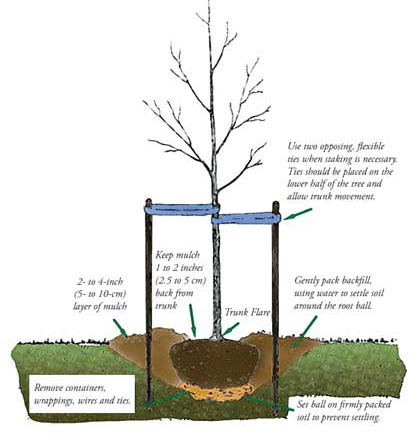
How to Plant a Tree- It’s Easier Than You Think Dig a hole 2-3 times as wide as the trees’ root ball but no deeper than the root ball. This encourages lateral root expansion. After removing the tree from its container, inspect the root ball for encircling roots and straighten or cut these. Place the tree into the hole, ensuring that the trunk flare (where the trunk expands at the base of the tree) is above the soil line. Step back and assess whether your tree is straight.
To Amend or Not to Amend- That is the Question!
Most of us are accustomed to amending our native soil with organic material when planting a new tree. However, Linda Chalker-Scott, Ph.D., Extension Horticulturist and Associate Professor at Washington State University explains in “The Myth of Soil Amendments” that plants grown in native soil show better root establishment and stronger growth. Dr. Chalker-Scott asserts that “no scientific studies to date show any measurable benefit of soil amendment except in containerized plant production.” To many of us in the Tree Steward program, the “no soil amendment” recommendation amounted to gardening sacrilege! Dr. Chalker-Scott acknowledges that soil amendment is often required in the specifications of architects and landscapers, and that there is a multi-milliondollar soil amendment industry that has no interest in debunking this myth. Local horticulturists note that the native river valley soil of Washington State is rich compared to that found in our desert southwest, and that soil amendment helps roots to establish. Interested readers may visit Dr. Chalker-Scott’s webpage at http://www.theinformedgardener. com where she provides many pithy retorts to garden myths.
As you begin to fill in the hole around your tree, stop to water the soil several times, creating a muddy slurry. “Mudding in” a tree helps the soil to settle firmly around the roots, reducing air pockets. Apply 2-4 inches of mulch over the soil around the tree, using natural materials such as leaf litter, pine straw or shredded bark. Staking of newly planted trees is not recommended; trees that move freely in the breeze develop stronger root systems. Staking may be needed when planting on windy sites (All of Gallup?). Stake removal is recommended after a year.
Water newly planted
Courtesy Photo trees weekly to keep soil moist but not waterlogged. Set your hose near the tree to run slowly and saturate the soil 2-3 feet deep around the tree. How do you know if you’ve watered enough? Push a 2-3foot-long piece of rebar into the ground around the tree. The rebar will only go down as far as the soil is moist. Water more frequently during hot, windy weather and taper off midfall as temperatures drop.