
State land commissioner blocks new uranium leases; Grants mayor says modern mining deserves a chance
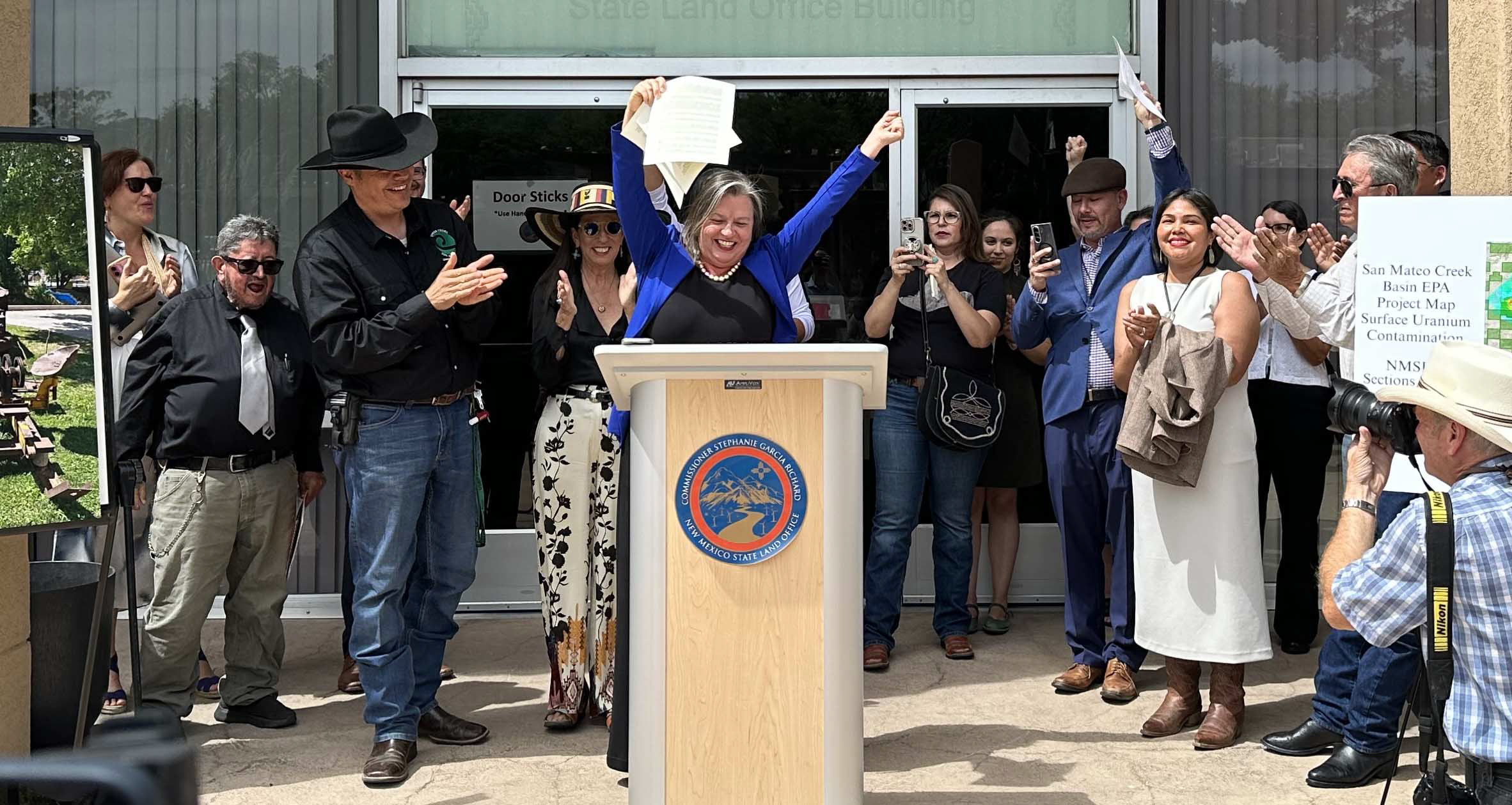
CIBOLA COUNTY, N.M. – New Mexico Land Commissioner Stephanie Garcia Richard has banned new uranium mining leases on state trust lands, escalating a growing fight over uranium development as several projects continue moving through permitting in and around Cibola County.
But the executive order does not amount to a statewide prohibition on uranium mining.
Executive Order 2026-002 prohibits the New Mexico State Land Office from issuing new leases for uranium mining and related activities on state trust lands. It does not stop uranium development on federal, private or Tribal lands, does not cancel valid existing mineral rights and does not automatically halt several uranium projects already advancing near Mount Taylor and elsewhere in northwestern New Mexico.
The distinction is especially important in Cibola County, where uranium has once again become one of the region’s most consequential economic, environmental and political issues.
Garcia Richard announced the order Friday, saying New Mexico should focus on cleaning up damage from the state’s historic uranium industry before allowing another generation of mining on state trust land.
“New Mexico has always been at the center of uranium production in this country, but our citizens have been ignored and disrespected by the industry and the federal government for far too long,” Garcia Richard said. “That stops now.”
The commissioner said she has not authorized uranium mining on state lands during her tenure and said the order formalizes that position.
Her action also places the State Land Office increasingly at odds with the federal government.
President Donald Trump’s administration has moved aggres- sively to expand domestic uranium production, describing uranium as critical to national security and energy independence while placing several New Mexico projects into accelerated federal permitting programs.
Some of those projects are in Cibola County.
What the Order Does – and Does Not Do
The executive order applies only to lands controlled by the New Mexico State Land Office.
That means it will not automatically stop projects such as La Jara Mesa, Roca Honda, Cebolleta or the Grants Precision In-Situ Recovery project, each of which involves different land ownership, mineral rights and regulatory structures.
La Jara Mesa, northeast of Grants within the Mount Taylor Ranger District, is a proposed conventional underground uranium mine being developed by Laramide Resources.
Roca Honda, near San Mateo, is a proposed deep underground mine being developed by Energy Fuels.
Both projects have been stalled for years but returned to active state and federal review as the Trump administration began prioritizing domestic uranium production.
The Cebolleta Uranium Project, meanwhile, is located on private land within the historic Cebolleta Land Grant and is being advanced by Premier American Uranium.
The Grants Precision ISR Project near San Mateo proposes a substantially different extraction method known as in-situ recovery, or ISR.
Instead of excavating uranium-bearing rock, ISR generally uses wells to inject a solution underground, mobilize uranium within the formation and pump the uranium- bearing solution back to the surface for processing.
The project remains in the permitting process.
Grants Mayor Sees Uranium Differently
Grants Mayor Erik Garcia said he disagrees with broadly shutting the door on uranium development and believes modern mining should be evaluated differently from the industry that operated in the region decades ago.
Garcia, who said he worked for years in mine engineering, acknowledged the serious environmental and health legacy left by earlier uranium development.
“They did it wrong,” Garcia said of the historic industry. “They went in and it was just for the money. They got everybody sick, and that’s why we have rules now.”
Garcia said that history should inform modern regulation, but he does not believe it should automatically prohibit new development.
“If you were going to come in and take off Mount Taylor’s top – our beautiful landscape – I would probably be on the bandwagon against doing that,” Garcia said.
But he argued that modern extraction methods, particularly in-situ recovery, deserve consideration.
Garcia said he believes improved engineering, environmental regulation and reclamation practices make today’s mining industry different from the uranium boom that shaped Grants and surrounding communities during the middle of the 20th century.
He also tied the discussion directly to Cibola County’s economic future.
For decades, uranium and coal supported thousands of jobs across northwestern New Mexico. Uranium production collapsed beginning in the 1980s, while coal production and coal-fired power generation have also declined across the region.
Garcia said communities such as Grants must determine what comes next.
“What’s the overall end game?” Garcia said. “We’re going to create economics. What’s the overall end game of energy? While coal is dying off, we have to figure out the next step.”
Garcia also pointed to nuclear power as a potentially important source of electricity as demand rises nationwide.
He said lower electricity costs could make an enormous difference to businesses such as his own, where he said monthly power bills can reach roughly $3,000.
Senator Charley Supports Ban
The announcement drew a very different response from Sen. Angel Charley, D-Acoma Pueblo, who represents the eastern half of Cibola County.
Charley joined Garcia Richard at the announcement and spoke about uranium’s effects on families and Indigenous communities.
“Uranium is part of the story of my community,” Charley said. “It is part of our families. And it is a history, a legacy we are still living with.”
Charley said communities should not be required to sacrifice their land, water or health for another uranium boom.
“We still have mines to clean up. We still have families who deserve justice,” Charley said. “And we daughters are still fighting for our fathers.”
The senator has become one of the Legislature’s most outspoken opponents of renewed uranium mining near Mount Taylor.
Earlier this year, Charley sponsored Senate Memorial 14, which urged state and federal agencies to oppose new uranium development around Mount Taylor.
A similar measure, House Memorial 37, was sponsored by Rep. Michelle Pauline Abeyta, D-To’hajiilee.
The measures were nonbinding but reflected growing political opposition to mining around Mount Taylor, a sacred landscape for the Pueblo of Acoma, Pueblo of Laguna, Zuni Pueblo, Hopi Tribe and Navajo Nation.
Mining Watch Applauds Order
New Mexico Mining Watch, a coalition of environmental, Indigenous and community organizations, praised Garcia Richard’s order.
The group said at least seven uranium exploration or mining permits are pending across state, federal and Tribal jurisdictions in New Mexico.
“This action didn’t happen in a vacuum,” Susan Gordon of the Multicultural Alliance for a Safe Environment said. “Communities that have lived with uranium contamination for generations have been showing up and demanding that New Mexico learn from its history.”
Mining Watch argues that instead of expanding uranium production, New Mexico should build an economy around cleaning up abandoned uranium sites.
The organization pointed to research from the University of New Mexico Bureau of Business and Economic Research that found uranium cleanup could create years of remediation, monitoring and skilled employment.
“The real economic opportunity for New Mexico is in cleaning up the uranium industry’s legacy, not creating new damage,” Gordon said.
A Legacy Still Visible
New Mexico was once the nation’s largest uraniumproducing state.
The uranium boom transformed Grants and surrounding communities, bringing jobs, population growth and economic prosperity.
It also left behind contamination that remains unresolved decades later.
The State Land Office estimates there are more than 1,000 former uranium mining, milling and exploratory drilling locations across New Mexico, including dozens involving state trust lands.
Many of the most heavily affected communities are in northwestern New Mexico.
The environmental legacy remains particularly sensitive around Mount Taylor and communities north of Milan, where historic uranium development occurred throughout the Grants Mineral Belt.
At the same time, the economic legacy is equally difficult to ignore.
Grants became known nationally as the “Uranium Capital of the World,” and generations of local families depended on the industry.
That history helps explain why the renewed uranium debate in Cibola County does not fall neatly along simple political lines.
For some residents and elected leaders, uranium represents contamination, illness and a legacy that remains unfinished.
For others, it represents jobs, energy production and the possibility of rebuilding an economy that never fully recovered from the industry’s collapse.
Federal Push Continues
While New Mexico officials debate uranium’s future, federal policy continues moving in the opposite direction from Garcia Richard’s order.
The Trump administration has made expanded domestic uranium production part of its larger national energy strategy.
Several New Mexico uranium projects have been placed into the FAST-41 federal permitting program, which provides enhanced coordination between federal agencies and is intended to speed the review of major infrastructure and energy projects.
FAST-41 does not eliminate environmental requirements or guarantee that a project will receive approval.
State regulators have also repeatedly said federal acceleration does not eliminate applicable New Mexico permitting requirements.
Earlier this year, the governor’s office told the Citizen that uranium mining requiring state authorization cannot legally begin without the proper state mining and groundwater permits.
The result is an increasingly complicated patchwork of federal, state, Tribal and private jurisdiction surrounding Cibola County’s uranium deposits.