
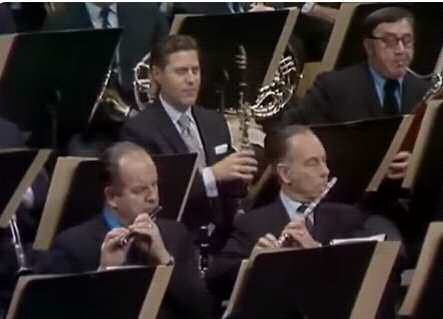
GRANTS, NM—Orchestrated music can be fun, not only long-hair sophistication. Gustav Holst, a 19th-century composer and music educator, did have a fun side. Holst was interested in English choral and folk music traditions. He was even a music master at St. Paul’s Girls’ School and was music director for Morley College in the early 1900s. But Holst had a creative and curious side and began to look for ways to express himself musically outside the accepted traditions.
By about 1914-1916, Holst was busily composing the tone poem, “The Planets”, today’s New York Philharmonic’s Young Peoples Concert presentation. The original NYP performance with musical director Leonard Bernstein was on March 26, 1972.
Bernstein conducts the Philharmonic in Holst's orchestral suite. Five of the seven movements 'Mars,' 'Venus,' 'Mercury,' 'Jupiter' and 'Uranus' - are performed, and then Bernstein improvises a musical theme for Pluto, whose discovery in 1930 postdated the Holst composition.
Do we ever think of orchestrated music playing themes about space? There’s the tone poem, Sprach Zarathustra, with its grand opening, “2001, A Space Odyssey”. That isn’t really about space, but Nietzsche’s philosophies.
“Then there's what's called sometimes spacedout music like certain rock music and certain experimental pieces by Stockhausen and avant-garde composers like that, which really have to do with the inner spaces of the mind,” the director educated us further.
LB calls it fun because the composer is not promoting anything, it’s not psychological or philosophical, but entertaining. Holst’s composition, “The Planets” is about the planets of the solar system. But not about astronomy. The composer’s main interest was astrology.
“It's just first-class entertainment. In fact, when it was first played in Germany around 1920, some of the critics there roasted it as being nothing but Unterhaltung Musick, which means entertainment music. Well, what's wrong with that? Especially if it's good…” Case won.
The composition was written for a larger-thanusual orchestra and specific instrument sounds were added. There is a bass oboe, sounding like a sunset, a tenor tuba, heralding a sunrise, or an army, an alto flute, restful, and an organ, which is many sounds all in one.
There are six horns, not the usual four, two sets of timpani, not only one, assorted other percussion instruments, and more. They “can make a terrific noise,” revealed the director, “spooky whispery sounds that seem to come from light years away.” He really prepped the audience for a special production.
There are seven planets represented in Holsts’ orchestration. He left out earth! We are the center of the solar system, astrologically speaking, but we are not seen in the heavens. Pluto, also left out only because it was not yet discovered when he first wrote the composition but had been by the time he died in 1934.
Mars, titled “Bringer of War” is the first movement. Mars is the red planet, and you can almost see tanks and marching soldiers as the part begins. It even sounds a bit industrial, like machines of war!
While calling the sound and theme ugly, Bernstein asks us to consider how it can be beautiful, because it is art. He reasons that if ugly art is done well, “doesn’t that make beautiful art?” Something to think about. For example, he compares the Mars movement to Picasso’s “Guernica”, Dickens, and Dostoyevsky.
The second planet is Venus, which the conductor referred to as, “an antidote to the ugliness of war,” and the “Bringer of Peace.” Starting with the French horn, a peaceful, mellow sound, and added to it are the woodwinds, all playing slow and gracefully.
Mercury, “The Winged Messenger”, is represented by harps, clarinet, and bassoons, playing the same tune in different keys and tempos, but lilting and happy. Additionally, there is what the conductor interprets as a Morse code sound played by strings, timpani, and glockenspiel, individually.
Jupiter is next, the much larger planet, and called Jollity. It is portrayed with orchestration, not only instrumental characters but also moments of joyful flutes.
Saturn Bringer of old age, which depressed the director enough that the orchestra skipped that movement and went on to the next planet, Uranus. Linked to Aquarius of late sixties “Hair” fame Uranus is labeled the planet of changes and reforms and is also called the magician. The movement sounds, at times, like Disney’s “The Sorcerer’s Apprentice” starring our favorite mouse, Mickey. You might find yourself bopping along with the tuba. (tuba?)
Pluto, a much later addition, was not discovered when this composition was written but was before Holst died. It is the darkest, least known, it moves slowly in a large orbit. “The Unpredictable” sounds, like tiny whirling objects coming at you, or flickering fireflies.
Cibola Arts Council presents a new Young Peoples’ Concert every Friday at 4 p.m. If you haven’t attended any of these productions yet, you have missed an opportunity to expand your artistic knowledge. With each performance, we have learned to hear the different sections of the orchestra, appreciate highlighted musicians, hear each instrument, and respect the knowledge, generosity, and talents of musical director, Leonard Bernstein. A learning experience is cumulative, but you must show up.
There is still a little time to hear a Young Peoples’ Concert, but the program will end this month. I hope you can make it to at least one performance.