
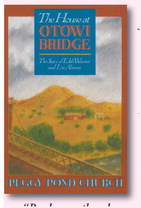
Title: “The House at Otowi Bridge” Author: Peggy Pond Church Artwork: Connie Fox Boyd Publisher: UNM Press, Albuquerque, N.M. Published: 1959, 1960 ISBN: 0-8263-0281-5
“Books are the plane and the train, and the road. They are the destination, and the journey. They are home,” author Anna Quindlen.
Two women, Edith Warner and Peggy Pond Church, guide the reader through a giant step back in time. Their letters and journals recount life in the 1920s in northern New Mexico including the advent of the Los Alamos labs and the onset of the atomic age.
Church grew up in New Mexico, but Warner left the East Coast and embraced life in New Mexico.
“Had I not come in that year of 1922 while the Boyds were at Frijoles, someone else might have lived in the house at Otowi bridge. Had they not taken me into their hearts I might never have known the people of San Ildefonso,” wrote Warner.
The thirty-year-old spinster accepted the job of operating the little boxcar railway station at the crossing of the Rio Grande river. The position included living quarters in a rundown adobe building close to the San Ildefonso pueblo which sits on the Parajito Plateau. (Parajito is the Spanish translation for the Tewa word, “Place of the Bird People.”) The new freight expert lived near the pueblo for more than twenty years. She chose to learn only a few words of their native language (Tewa) because Warner believed their customs should remain private from Anglos, especially anthropologists.
The Church grew up exploring the mesas surrounding the village of Los Alamos. She was a young wife with a new baby when she first met Warner. She often sought guidance from the older woman while visiting the tea shop that Warner had opened in her house.
Warner and Church witnessed the federal government’s use of Eminent Domain in 1942 to claim ownership of several thousand acres of the Parajito Plateau and the surrounding mountains. Then the area was closed to residents because the Los Alamos project was working on a top-secret program - developing the atomic bomb.
Later the tea shop became a refuge for the scientists and their wives who enjoyed Warner’s home cooked dinners. For a while she served evening meals five days a week. Poor health eventually forced her to reduce the schedule to three nights a week.
“For many the little house at the river was a landmark, for some an experience. For me it was two decades of living and learning,”wrote Warner.
She remembered the faces of the many scientists and how they talked about their families, music, and mountain climbing when they had supper at her tea house.
“In the days after Hiroshima [Japan] she had seen many of these men recoil at the implications of what they had done,” said Church in her description of Warner’s later life.
Warner had always valued the privacy and sense of isolation that her home by the bridge provided, but in 1946 the U.S. Army began building a new bridge at the crossing. She found the constant roar of heavy machinery and dust unbearable.
Warner decided to move in 1947; her new place was farther from the Rio Grande but offered different vistas of the mesas.
And the stream of visitors to her new home continued even as Warner’s health deteriorated. Eventually she became too ill to leave her bed.
“From the bed I can see the first light on the mountains, watch snow clouds rise from the glistening Truchas [mountains], follow the sunset color from the valley to the sky,” wrote Warner in 195l shortly before she passed away.
Church grieved for her long-time friend but rejoiced that Warner was buried at the San Ildefonso pueblo where she had observed so many of their sacred rituals.
“On the high Parajito Plateau west of the river, where I as a child I used to hunt for arrowheads among the pueblo ruins, the city of Los Alamos now sprawls with its fierce and guarded laboratories, its rows of modern houses, its theaters, and flashy supermarkets. The paved road that runs from north to south across the plateau parallels the remnants of an old trail worn ankle-deep in places by the moccasin-feet of Indians,” wrote Church in 1959.
SIDEBAR:
Margaret Hallett Pond (1903 –1986), an American author, used the pen name Peggy Pond Church. She lived in Los Alamos, N.M. for more than 20 years prior to WWII. Church became a lifelong pacifist and supported the anti-violence Quaker movement as a consequence of the work done at the Manhattan.
Her writing career began at age 12 with the publication of her poem 'Ode to a Flower.” Church’s poetry was included in the Alice Corbin Henderson 1928 anthology The Turquoise Trail.
The author received the 1959 Longview Literary Award for portions of this book when it was published in the New Mexico Quarterly. She was awarded the 1984 New Mexico Governor's Award for Excellence and Achievements in the Arts.
“The House at Otowi Bridge” is available from UNM Press.
New Mexico artist Connie Fox Boyd created twenty pen-and ink sketches for this book. Her prize-winning paintings have been displayed in the Southwest and in New York.