
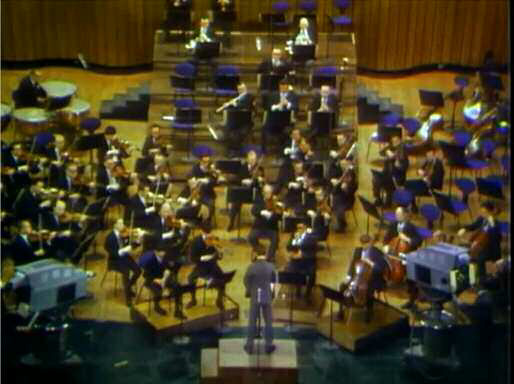
GRANTS, NM--Musical Director, Leonard Bernstein, opened the evening’s Young Peoples’ Concert: Young Performers No. 8, with a social comment on the growing acceptance of music, and how America has a new attitude. He shared how, when he was a boy, he was thought to be a little crazy for leaving baseball practice to attend his piano lessons.
This concert was performed live on February 27, 1967. The Director also drew the audience’s attention to the fact that none of the young performers were pianists. This might have surprised some because, as he also pointed out, the piano seems to be the favorite instrument of new musicians, along with electric guitar, drums, and band instruments like the clarinet and trumpet. All were absent from this performance.
A creative mind is always finding new ways to express its ideas. Bernstein certainly had a creative mind. This year’s performance allows soloists, other than pianists, to showcase their talent. As a group, the four musicians perform a piece by Haydn, written for orchestra and four soloists; a violin, a cello, an oboe, and a bassoon.” What a coincidence.
The solo performers are Elmar Oliveira on violin, Mark Salkind on oboe, Fred Alston on bassoon, and Donald Green on cello. The musicians performed Haydn’s Sinfonia Concertante in B-Flat Major with guest conductors Juan Pablo Izquierdo conducting the first movement and Sylvia Caduff conducting the second and third movements. Both assistant conductors were chosen through the annual Dimitri Mitropoulos competition held each year. The NY Philharmonic chooses the assistant conductor each season.
Young Elmar Oliveira, 16, was from Waterbury, Connecticut. He picked up his first violin at age 9 and continued to have a distinguished career. Following his New York Philharmonic performance he achieved international recognition, winning Gold Medal at Moscow's prestigious Tchaikovsky International Competition, the first and only American to win this award. He was the first violinist to receive the coveted Avery Fisher Prize and won First Prize at the Naumburg International Competition. (Biography (elmaroliveira.com) Mark Salkind of San Francisco was 13 when he was part of the Young Performers program with the NY Philharmonic. Though he has remained involved with music, his career took a different avenue. He was one of the first students at a new school, the Urban School of San Francisco, a primarily performing arts school. After achieving his degree from Yale in English Literature, Salkind returned to San Francisco, worked for a while in a music store, but later became involved with Urban. This involvement led to his appointment as Head of School in 1986. After
32 years with Urban, Salkind retired in 2019. (Mark Salkind: The man behind the building – The Urban Legend (urbanlegendnews. org)
On bassoon was Fred Alston, 19, from Philadelphia. As for many of the young musicians who were honored to play with the NY Philharmonic, Alston continued to expand his musical career following this appearance. In 1972 he performed with the Concerto Soloists Chamber Orchestra, and in 1971 he became “the first African American classical musician to hold the position of principal bassoon with the New Jersey Symphony Orchestra.” Alston made a significant impression as a musician in the world of bassoonists. He passed away in 2022. (Copilot with GPT-4 (bing.com) Twenty-year-old cellist, Donald Green, from New Haven, Connecticut, wasted no time joining an orchestra and advancing his career. In 1975, following college at the University of Southern California, Green played for the Detroit Symphony as the Principal Trumpet until 1982, immediately followed by a position with the LA Philharmonic as Associate Principal until 1999.
Still an active musician, Green is the Principal Trumpet with the Los Angeles Philharmonic Orchestra. (Los Angeles Philharmonic Player Bios - View topic: Trumpet Herald forum) Juan Pablo Izquierdo, conductor for the first movement of Haydn’s piece, is a Chilean-born conductor. His very active career has been international, working with major orchestras primarily in Europe and South America. Having won the Dimitri Metropoulos International Competition for Conductors in 1966, Izquierdo was chosen to be the season’s assistant conductor for New York Philharmonic Orchestra under the supervision of Leonard Bernstein. Since then, he has conducted such major orchestras as the Jerusalem Symphony, the Gulbenkian Orchestra in Lisbon, and the Santiago Philharmonic, to name only a few in his extensive career. The now white-haired conductor is currently the Conductor Emeritus for the Carnegie Mellon Philharmonic and the Santiago Philharmonic Orchestra. These are only a meager few of his ambitious accomplishments. The conductor has also won numerous awards and has earned recognition for his interpretations of the Viennese Masters and the avantgarde compositions of the twentieth century. (Juan Pablo Izquierdo) Conducting the second and third movements of Haydn’s Sinfonia Concertante was Sylvia Caduff of Switzerland. Her early career had several firsts. She was the first woman to win the Dimitri Mitropoulos Competition (1966), and the first European woman to hold the position of General Director of the Orchstra of the City of Solingen, Germany.
Following her assistantship with the NY Philharmonic, she officially conducted the orchestra the next year when Bernstein suffered an illness.
Caduff’s rise to prominence is an interesting story. Like women in other professions, she was passionate about her career which happened to be dominated by men. She was encouraged, while still a student at Lucerne Conservatory, by Herbert von Karajan, a renowned conductor. When she asked him how he felt about women conducting, his surprising reply was, 'If you are gifted why not conduct?' With these encouraging words, Caduff became unstoppable on her journey toward becoming a noted, female, conductor. (Cadu , Sylvia (1937—) | Encyclopedia.com) There must be many fans of the accordion, but do we think of it as an orchestral instrument? That was Bernstein’s point when he introduced Stephen Dominko who was going to play an arrangement of a Chopin piano concerto that had been rearranged for the accordion.
“His instrument is one that is really rarely taken up by American youngsters, especially in a serious way…But the way Mr. Dominko handles this old picnic and campfire instrument is simply astonishing … his accordion isn't just that old wheeze box we remember from vaudeville days. It's a magnificent and rare Italian instrument, with a range of five octaves a marvelous singing tone, and all kinds of extras,” said the maestro in his introduction.
So, we can rightly expect the arrangement for the accordion of Chopin’s Piano Concerto in F minor to be worthy of inclusion in this concert. And of course, it is. Each young musician has passed an audition, and so was especially chosen for this event. You can imagine there must have been some very stiff competition. Dominko is the only accordionist to have played with The New York Philharmonic. Dominko, who passed away in 2017, left a list of accomplishments he attained with his beloved accordion. He received awards, made appearances, and recordings.
When Dominko was only four, he was greatly impressed by the beauty of the accordion he heard in a recording. After that, he began his own lessons on the instrument. By the age of ten, he made a TV appearance, and his concert career followed, playing Carnegie Hall at fourteen and again when he was eighteen.
In 1964 at age seventeen, Dominko became the youngest-ever world champion when he won the Confédération Internationale De Accordéonistes (CIA) Coupe Mondiale an International Competition for Accordionists held in Toronto, Canada that year.
Later, but not much later, in 1966, he won an audition to play with The New York Philharmonic directed by Leonard Bernstein.
(Stephen Dominko Obituary (1947 - 2017) Washington, NH - Union Leader (legacy.com); Stephen Dominko (1947-2017), New Hampshire – USA - Accordions Worldwide Weekly News) How do you follow that? You must follow with another remarkable soloist, twenty-one-yearold basso, George Reid. One reason Reid was impressive was not only for being a basso at only twenty-one but also because he had only studied music for two years. Reid’s choice of songs to sing was a selection from Mozart’s The Magic Flute, 'In Diesen Heil'gen Hallen', and was accompanied by conductor Izquierdo.
There is little to no information about Reid’s career or progress with his singing following this appearance. The exception is a February 18, 1970, concert with the Metropolitan Opera at the New York Cultural Center. Reid appeared with mezzo-soprano Federica von Stade. He is also known to have worked with the Metropolitan Opera Studio in designing, writing, and producing the Opera companies' work. (About - Metropolitan Opera Studio (metoperastudio. org) (Miss von Stade, a Mezzo, Gives. Concert With George Reid, Bass - The New York Times (nytimes.com) The final performance was by nineteen-year-old Young Uck Kim, violinist. Bernstein expressed his admiration for this young artist by describing his performance technique as passionate and totally absorbed in the music.
“When he plays the violin, as you're about to hear, he is performing an act of total living total absorption. Everything is blotted out for him and for us except this one musical experience.”
Bernstein was the conductor for Kim’s performance of Saint-Saëns’s Violin Concerto No. 3 in B Minor.
As obscure as Reid’s history is, Kim is all over the web. He began his study of the violin at age 6 and was playing with the Seoul Symphony Orchestra by age 11. In 1976, he made his N.Y. recital debut at Alice Tully Hall in Lincoln Center. In 1979 he began his relationship with musicians Emanuel Ax, a pianist , and the renowned cellist, Yo-Yo Ma. (Kim, Young-Uck | Encyclopedia.com) The trio toured extensively and played Dvorak’s Piano Trio No.3 in F minor, Op.65 at Edinburgh Queen’s Hall in 1983 for the Edinburgh International Festival.
A piano trio is a group of piano and two other instruments, usually a violin and a cello, or a piece of music written for such a group. It is one of the most common forms found in classical chamber music. The term can also refer to a group of musicians who regularly play this repertoire together (Piano trio Wikipedia) Thank you for your attention to these articles about Young Peoples Concerts. The next one, Young Performers Concert No. 9, will be the final for this series. There will be a new schedule from the Cibola Arts Council.