
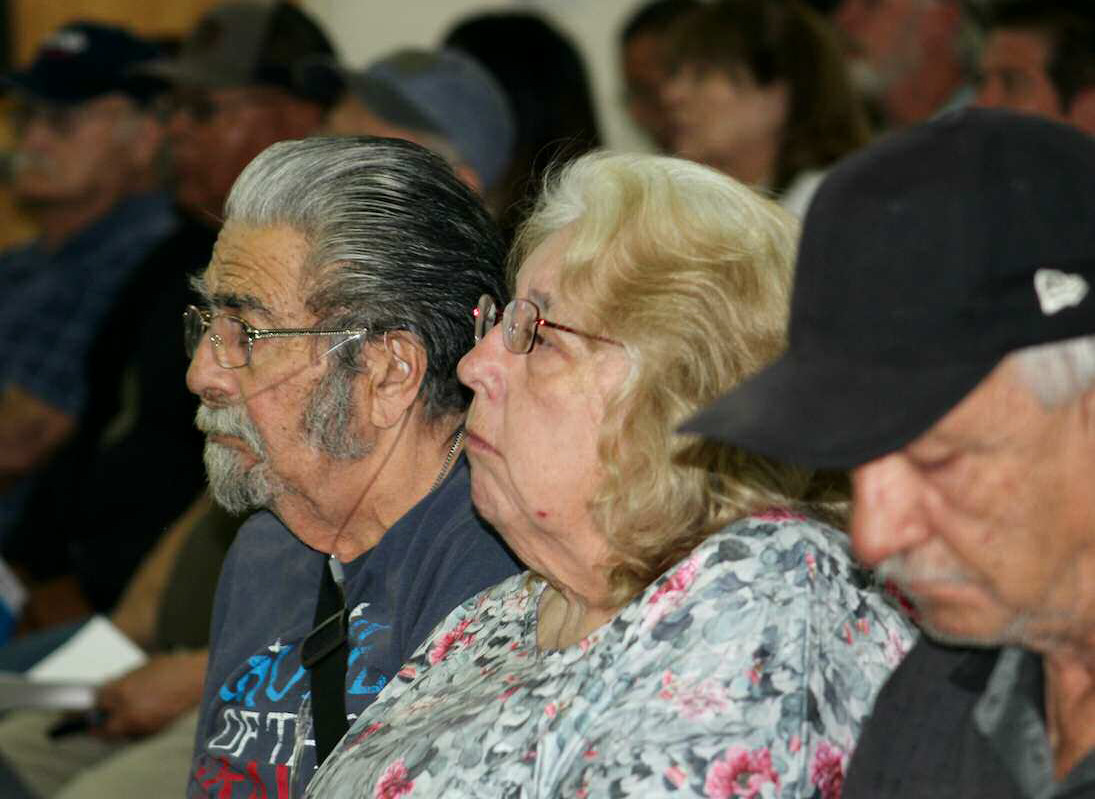
Two days before Earth Day – coincidentally, the birthday of J. Robert Oppenheimer, father of the atomic bomb – workers sickened from radiation exposure gathered in the former “Uranium Capital of the World” for a meeting called by the Post-'71 Uranium Workers Committee.
Among the nearly 135 surviving uranium industry workers and family members who filled the Cibola County Complex was Joe Vigil, who celebrated his 83rd birthday a week earlier. Vigil got his start in mining in 1958. Anything that pertained to mining and drilling, he could do, he said. “I never went without a job.”
Vigil came to Cibola County in 1976 and went to work for Gulf Mineral Resources Co. at the Mount Taylor Mine, a halfmile from the village of San Mateo. Gulf started production in 1980, with miners extracting ore from two 3,300-foot-deep shafts. Production continued until September 1982 when uranium prices fell and the mine went into temporary shutdown.
“When they closed the mine down in the '80s, I left. I went to Carlsbad, New Mexico, where they store the radiation – the WIPP place,” he said. The Waste Isolation Pilot Plant, a deep geological salt-bed repository, is licensed to store transuranic radioactive waste from the research and production of nuclear weapons for 10,000 years.
Oh, those golden years
Vigil eventually worked his way across the United States and was offered jobs in Chili, Peru, Argentina, Puerto Rico, and south of Mexico near Guatemala. “But when the wars break out, then the contracts are over. They won’t take you,” he said.
In the early '90s Vigil went to Waxahachie, Texas, about 30 miles outside Dallas, to work on the Superconducting Super Collider, a 54-mile particle accelerator canceled by Congress in October 1993 after an expenditure of $2 billion to bore a 14-mile tunnel. At first Vigil didn't pass his physical. He failed the drug test. “I was very upset because I never done drugs in my life. I had to go back and see the doctor and all it was, is I took an Advil pill,” Vigil said. “But that’s when the doctor told me that he found a trace of diabetes.”
At the age of 60 Vigil had earned enough credits to retire, according to Human Resources. He said he was told, “'I’m going to have to lay you off. No other company is going to hire you, so I’m going to put you in for disability retirement.' “That’s how they retired me – not that I wanted to. I wanted to work till at least 75 or 76.” But that didn't happen. “I ended up with this,” Vigil said, pointing to his oxygen gear. He has pulmonary fibrosis and also is on dialysis.
“I've been to a lot of meetings – a lot of meetings,” he said, shuffling medical papers inside a folder. “I don't know why I don't qualify but that's where I'm at.”
Never-ending battle
The Post-'71 Uranium Workers Committee has been meeting for the last 17 years to keep the miners, millers, ore transporters and core drillers, among others, apprised of bills before Congress that might amend the Radiation Exposure Compensation Act of 1990 – the one law that could compensate them.
RECA has been the only glimmer of hope for those employed by the uranium industry after Dec. 31, 1971. Although uranium mining was still booming in the Grants area in the early 1980s, the cutoff date for RECA eligibility was set at Dec. 31, 1971, based on the end of the federal government's uranium procurement program under the Atomic Energy Commission.
Those workers who came after 1971 weren't supporting the war effort like pre-'71ers. They worked for commercial contractors so they weren’t counted.
That argument doesn't make a hill of beans to Linda Evers, a Post-'71 uranium mill worker. “They've used that excuse to us many times. But I keep coming back to, 'I don't care who's buying the dirt, the government is responsible for worker safety.' “Right now, you can go out to any tailings pond and those guys are wearing what we wore: jeans and T-shirts, ball caps and safety glasses, and steel-toed boots.
“They still are not protecting uranium workers,” Evers said. “So until they get it through their head that you either protect the people or you compensate the people, we're going to have a neverending battle.”
Unless RECA goes away, that is.
Two years ago President Joe Biden signed into law the RECA Extension Act of 2022 which kept the RECA Trust Fund – the not-so-deep pocket that pays the claims – on life support and extended the filing of claims deadline another two years. That extension ends June 10.
Republican Sens. Mitt Romney and Mike Lee of Utah introduced a no-frills bill April 30 to reauthorize RECA. Rep. Celeste Maloy, R-Utah, is leading the effort in the House. If passed by Congress, RECA will be alive and kicking for two more years.
“If the RECA program dies, it's just done,” Evers said. “There's no amendments, there's no compensation for any of us workers.”
Not dead yet
Evers and Liz Lucero, along with her late husband Cipriano, a mill worker, formed the Post-'71 Uranium Workers Committee in 2007. Along the way they connected with the Killian and Davis law firm of Grand Junction, Colorado, where Jennifer McCall, longtime paralegal and RECA specialist, has been tracking the proposed amendments since heaven started, or so it seems.
“We're watching everything that's going on in Congress right now,” Evers told the crowd. “It's the government that hasn't been doing anything.”
While waiting for the government to do something meeting-worthy for Post‘71ers, Evers dealt with her own health issues. Admittedly, she's not as spry as she once was, but it was a bit disconcerting during that time to be confronted with a rumor of her untimely demise.
“When the lawyers called me from Grand Junction and asked me when did I pass away, I had to check my pulse,” she said. “Here I am. I didn't die. We're still working for RECA.”
Signed into law by President George H.W. Bush in 1990, RECA established lump-sum compassionate payments of up to $100,000 each to compensate sickened miners, millers and ore haulers essential to the nation's nuclear weapons development. Onsite participants at nuclear weapons tests are eligible for up to $75,000 each and individuals living downwind of atmospheric testing in the Marshall Islands and Nevada Test Site are eligible to receive $50,000 for their illnesses.
But like the post-'71 workers who haven't gotten squat from the government for their exposures, New Mexicans near Alamogordo awoke the morning of July 16, 1945, to find they, too, were expendable. Overnight, they had become the unwitting recipients of radioactive fallout from the government's first atomic experiment at White Sands Missile Range. They remain ineligible for compensation.
Still here
Since the release of Christopher Nolan's Grammy-award winning movie “Oppenheimer,” on the development of the atomic bomb, the voice of the uranium workers has been lost among the cries of downwinders in Washington, according to Evers.
“We have to get their attention again,” she said. “Oppenheimer wouldn't have had anything to play with if we hadn't gotten the uranium out of the ground, if we hadn't milled it, if we hadn't hauled it.”
The post-’71 workers breathed in the same radon daughters as the pre-1971 miners. They got the same cancers. They even had scientific data to support their claims. But Washington wasn’t listening to that.
What could they do between doctor appointments to further their cause? Calling members of Congress and writing letters to Washington for nearly two decades didn't appear to work. What had it gotten them so far? The shaft. Once again.
It sure as hell hadn't gotten them medical coverage.
While the audience in Grants was reflecting on the $100,000 payments to pre'71 workers vs. the treatment of post-'71 workers and their contributions to national security, members of the U.S. House of Representatives were in Washington haggling over a $95 billion foreign-aid package for Ukraine, Israel, Taiwan and the Indo-Pacific.
“What really aggravates me is the fact that we’re sending billions and billions of dollars to other countries – and they can’t even give us a slice of that money to take care of our families,” Cibola County Sheriff Larry Diaz, a post-'71 miner, said.
As of April 26 the federal government had compensated Cold War uranium victims $2.67 billion under RECA. Of that amount $1.33 billion went to downwinders, according to the U.S. Department of Justice. An awardsto- date summary shows that claims now pending include 145 downwinders, 60 onsite participants, 33 uranium miners, three uranium millers, and four ore transporters.
(Kathy Helms is an award-winning journalist who has focused on nuclear and uranium issues for three long decades.)