
“A book is like a key to unknown chambers within the castle of one’s own self,” Franz Kafka
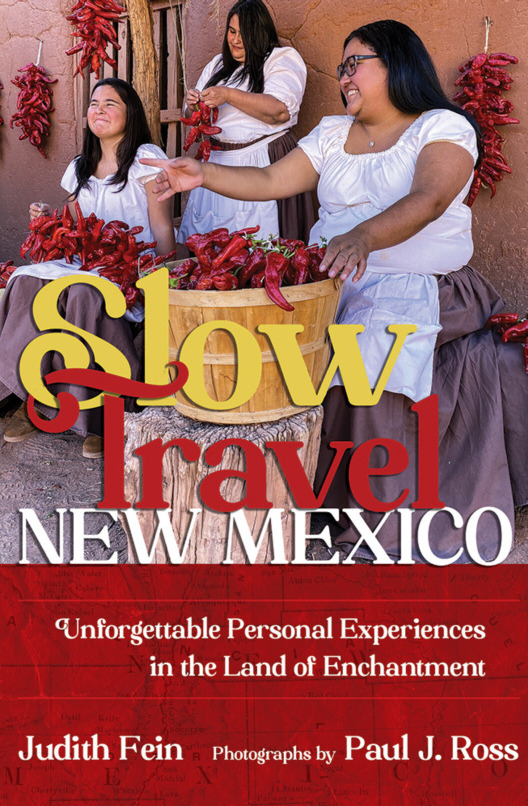
The exquisite photography of Paul J. Ross is the perfect accompaniment to Judith Fein’s descriptions of life in the Land of Enchantment.
This travel guide, one of ten in the UNM Press Southwest Adventure series, explores New Mexico’s history, art, music, culture, paleontology, ecology, mysticism, wildlife, and outdoor adventure opportunities. Each section provides interviews with local artists and residents plus photography tips by Ross along with websites and phone numbers for additional information.
The Northwest region, 46 pages, is focused on Gallup, the Zuni Pueblo, the Navajo Nation (which spans the Four Corners of Arizona, New Mexico, Colorado, and Utah), Ramah and the Wild Wolf Sanctuary plus the El Morro National Monument. The spring hidden at the base of Inscription Rock has been an oasis for Native Americans, Spanish conquistadores, and 19thcentury emigrants for more than a thousand years. Inscription Rock, part of El Morro, is internationally recognized for the two thousand etchings that span centuries of human history.
The North Central section, Part Two, 74 pages, highlights Santa Fe and its famous opera house which hosts opera stars from around the world, Abiquiu (home of world-renowned artist Georgia O’Keeffe), Chimayo, Ghost Ranch, Lamy, and Fort Union. Lamy is the site of Willa Cather’s book, “Death Comes for the Archbishop,” that was originally published in 1927.
Part Three, 43 pages, features historic towns in the northeast like Pecos, Raton, Cimarron, Angel Fire, and Tierra Amarilla along with other interesting locations such as the Vermejo ranch, which is a 550,000-acre nature reserve that extends into southern Colorado. The author describes their encounter with local shepherds along Route 64 as they headed toward Tierra Amarilla.
“We started bringing the sheep (more than 1,500 in this herd) down [from the mountains for the winter] yesterday on horseback, with sheep dogs. In Tierra Amarilla they won’t be in pens. They can eat there and on the surrounding ranches,” explained the sheepherder.
(The 1967 raid on the Rio Arriba County Courthouse in Tierra Amarilla put a spotlight on Hispanic land grants, which were parcels of real estate ceded by the Spanish government or by the Mexican government to a community or town in what later became the United States.
Raton, Colfax County seat, is located within the original 1,714,765-acre Mexican Maxwell Land Grant, the largest grant ever made.)
Part Four, 34 pages, describes Albuquerque, the Ojito Wilderness, Los Alamos, Valles Caldera and other aspects of the Central region, which is home to a majority of the state’s population.
“When we visited in the fall, nature exploded into brilliant golden hues, and we were often alone as we set out on a long walk into the mystery of the [Valles] Caldera,” wrote Fein.
“We thought of the ancient hunters who visited the site as early as 11,000 years ago. They gathered obsidian to make arrow points and spears and traded them across a wide swath of the Southwest.”
This region includes Albuquerque in the Middle Rio Grande Valley, Los Lunas, and Mountainair. The 1946-50 drought was the death knell for Mountainair’s claim as the “Pinto Bean Capital of the World.”
The 64 pages of Part Five, Southwest, take the reader on adventures exploring the Gila Cliff Dwellings, learning about historic Mimbres pottery, Mesilla Park and pecan orchards, Las Cruces, and the Chihuahuan Desert Nature Park along with the artists of Hillsboro.
“I had no idea we’d find so many Victorian homes. I didn’t know we were in Apache country,” explained Fein. “Paul had no idea it would be so photographically promising.”
Part Six, 67 pages, describes the Southeast region including Ruidoso, information about the outlaw Billy the Kid, axthrowing, the ancient traditional ceremonies of the Mescalero Apache, and more.
“Everywhere you look there are fields of lava [in theValley of Fire Recreation Area]. And over there you can see White Sands and the Trinity Site where they detonated the first atomic bomb,” commented one area resident. “It makes me think that destruction comes from nature and from human nature.”
New Mexico, the 47th state admitted to the U.S., is geographically the fifth largest state. It shares boundaries with Colorado to the north, Oklahoma and Texas to the east, the Mexican states of Chihuahua and Sonora to the south, and Arizona to the west.
This region was claimed by Spain in the 16th century; it became part of Mexico in 1821; and was ceded to the United States in 1848 through the Treaty of Guadalupe Hidalgo.
Tensions between Spanish American (Hispano), Native American, and Anglo populations are an ongoing reminder of the antagonisms that characterize the long history of the Land of Enchantment.
SIDEBAR
● Judith Fein has contributed to 130 international publications during her prolific career as a travel and cultural journalist. She is a regular contributor to “Psychology Today.” Fein is the author of “Life is a Trip: The Transformative Magic of Travel,” which is one of her three award-winning travel books.
● Photojournalist Paul J. Ross is a two-time winner of the Travel Classics award and is a cowboy poet. His work has won numerous awards and he has contributed to more than ninety publications.