
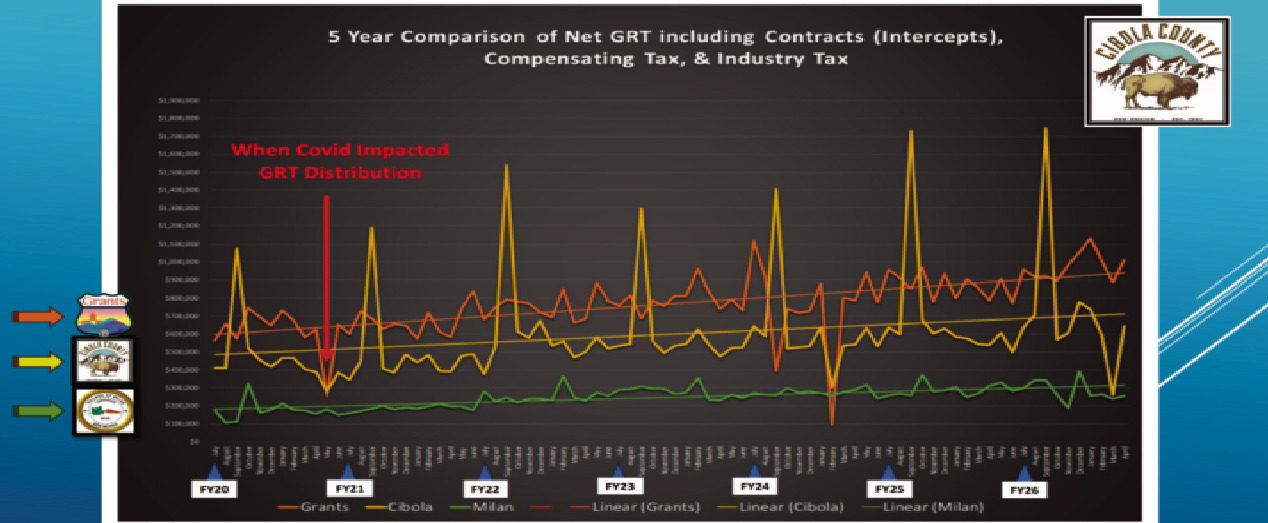
GRANTS, N.M. – Readers looking at Cibola County’s gross receipts tax collections may notice an unusual drop in the county’s March 2026 distribution near the end of the five-year comparison chart.
According to Cibola County Finance Director Paul Ludi, the sharp decline was tied to a one-time adjustment involving amended tax returns from a statewide entity with a location in Cibola County.
Gross receipts tax, often called GRT, is one of the major revenue sources for local governments in New Mexico. This tax is collected when a consumer purchase goods and services, and is then distributed to state and local governments. For counties, municipalities and other local entities, those monthly distributions help support public services, operations and long-term budgeting.
The chart compares net GRT, including contracts, compensating tax and industry tax, for Cibola County, the City of Grants and the Village of Milan over five fiscal years. While the broader lines show local revenue moving up and down from month to month, the county’s March 2026 distribution stands out because of the size of the decline.
In this case, the March distribution was lower than usual because the New Mexico Taxation and Revenue Department clawed back revenue after the entity amended several years of returns to claim a medical deduction.
David Monteith, local government liaison with the New Mexico Taxation and Revenue Department, told Ludi the adjustment affected Cibola County’s March 2026 distribution and produced a decrease of $241,817.93.
“A statewide entity with a location in Cibola County amended several years of returns to claim a medical deduction, which resulted in a clawback from the affected jurisdiction,” Monteith wrote in an email to Ludi.
Editor’s Note: After publication, the New Mexico Taxation and Revenue Department clarified that the March 2026 gross receipts tax adjustment followed an amended return filed by the taxpayer, not by the department itself. The department said it processes amended returns but does not file them, and that taxpayer identity information is confidential.
Monteith also said he was seeking additional information from the department about the application of the medical deduction and the basis on which it was approved.
“At this time, it appears to be a one-time occurrence and is not expected to affect future distributions,” Monteith wrote.
That distinction matters because GRT charts can be useful indicators of local economic conditions, but this is an instance where monthly changes do not always tell the whole story by themselves. A single month can be affected by delayed payments, corrections, amended returns, deductions, refunds or other adjustments that move through the state distribution system.
In Cibola County’s case, the following rebound helps explain why officials are treating the March figure as an unusual one-month event rather than a new trend.
The broader pattern of GRT collections remains important to watch because it reflects taxable activity taking place in the county and affects the ability of local governments to plan services, projects and budgets. But county officials have indicated this particular drop was tied to a specific tax adjustment and is not currently expected to continue.
March 2026 should be read as an outlier month shaped by a state tax correction as the overall collections remain strong.