
Drought conditions appear to be improving in Cibola, but the truth is that the conditions are slowly worsening once again.
Through the month of October, drought conditions worsened across the county, a worsening that was stalled thanks to significant precipitation across the month. Cibola County recorded October 2022 as the 12th wettest October over the past 128 years, according to the National Integrated Drought Information System.
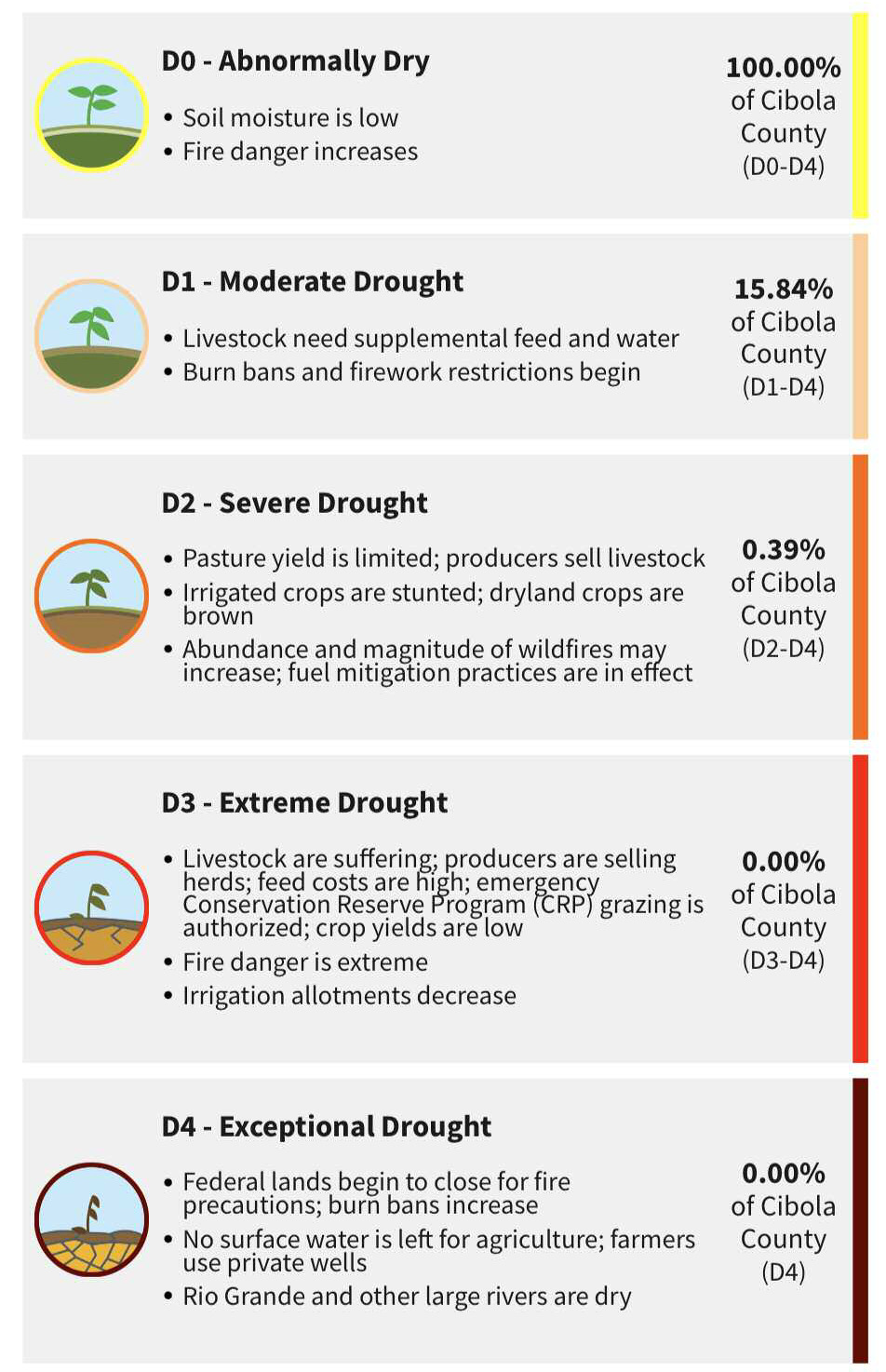
Despite seeing a worsening trend, only 15.84 percent of Cibola County is in a moderate drought. The county remains in drought as 100 percent of Cibola is suffering through abnormally dry conditions, according to NIDIS.
The improvements in conditions mark significant improvement in drought across the county. In 2022, Cibola suffered through the driest May over the past 128 years of drought tracking in the county, the area was suffering so badly that scientists who conduct drought tracking declared Cibola was in an “Exceptional Drought” the worst level of drought recognized by the federal government. In June 2022, a large wildfire, the Cerro Bandera Fire, destroyed 939 acres of land in the Zuni Mountains. Fire personnel in Cibola rallied together after the fire, asking for increased fire restrictions through the month of June, especially because the Independence Day holiday was rapidly approaching and residents often celebrate with fireworks. At the time, the drought rating in Cibola was at the highest rating recognized by federal authorities who track drought across the country. Increased rainfall at the end of June, that continued through July, was enough for local governments to lift firework restrictions. Rainfall, despite expectations by meteorologists, did not stop after the holiday. Rainfall has since continued to persist.
Today, zero percent of Cibola County is in exceptional drought. Zero percent of Cibola is in extreme drought, and only 0.39 percent of Cibola is in severe drought, the far northeast area.
“Exceptional Drought” Tracking
Cibola’s rainfall lessened the shock of the “Exceptional Drought” back in May.
2013 was the first time Cibola entered the “exceptional” category, the rating lasted for several months before ending.
While the county remained in drought, it was not given the “exceptional” rating again until 2020. The rating was assigned in December, and persisted through most of 2021.
May of 2022 saw the worst “Exceptional Drought” in county history. The United States Drought Monitor tracks the severity and length of drought across the country. The severity of 2022’s “Exceptional Drought” was starkly more severe than either of the previous two times this rating was assigned to Cibola. However, 2022’s situation lasted for a shorter amount of time than either of the previous two instances.
Current Drought Rating
Despite how dry the first half of 2022 was for Cibola; monsoon rains have pulled the county from the brink of disastrous drought. Increased rainfall has made the area greener while improving conditions for farming and livestock.
According to the United States Department of Agriculture, 71 acres of hay are estimated to be in drought, this is down from 425 acres in July. Only 5 acres of haylage, down from 28 in July, are suffering from drought. The USDA estimates that 1,629 cattle and 479 sheep are in drought across Cibola, down from 9,743 and 2,868 respectively in July.
Cibola’s fire teams remind residents to take extra care when starting fires to stay warm. When using a portable electric heater, never plug it into a power strip, and to plug it directly into the wall to avoid causing sparks which might spark a fire. Cibola’s drought may be improving but 100 percent of the county remains in “abnormally dry” drought where fire danger increases, according to the USDA.
Drought Data
The National Integrated Drought Information System is a tool used by the National Oceanic and Atmospheric Administration; a department of the United States known by many as the team who tracks Santa Claus during the Christmas holiday. NIDIS has been tracking drought in the Cibola area since 2006, and they use other historic data and environmental sampling to get a drought reading on years prior, all the way up to 1894.
Much of the data Cibola Citizen utilizes comes from NIDIS, but also NOAA and the US Department of Agriculture and the National Agricultural Statistics Service. These entities supply data for Cibola’s acreage of hay and number of livestock.