Pueblo of Acoma objects to the proposed rollback and says the federal government has not provided meaningful consultation; comments are due July 29

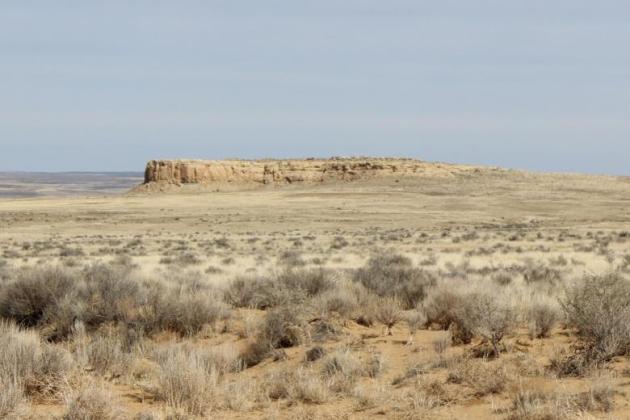
Distant mesa within the Chaco Withdrawal Area. Photo courtesy of BLM.
PUEBLO OF ACOMA, N.M. – The Bureau of Land Management on Wednesday released a draft environmental assessment proposing the full revocation of federal protections covering approximately 336,404 acres around Chaco Culture National Historical Park, opening a 14-day public comment period that will close July 29.
The proposal would undo Public Land Order No. 7923, which established a 10-mile buffer around the park and closed federally managed lands within that area to new mineral leasing and mining claims for 20 years. The 2023 order remains subject to valid existing rights and does not apply to state, private, Navajo Nation trust or individual allotment lands.
BLM’s draft considers three possible outcomes:
- The agency could leave the existing 10-mile withdrawal in place
- Revoke the 10-mile buffer entirely or
- Retain protections within five miles of the park while reopening federal lands beyond that distance.
The agency identified full revocation, option 2, as its proposed action.
If approved by the secretary of the Interior or another designated official, all 336,404 acres covered by the withdrawal would again become available for mineral leasing and mining under the 2003 Farmington Resource Management Plan.
“The BLM welcomes input from stakeholders as we analyze the environmental effects of revoking the withdrawal of public lands surrounding Chaco Culture National Historical Park,” BLM Director Stevan Pearce said in the agency’s announcement. “Gathering and considering these perspectives is a vital part of our process and to our mission of managing public lands for the benefit of all Americans.”
The review follows President Donald Trump’s Executive Order 14154 and Interior Secretary’s Order 3418, which directed federal officials to review restrictions affecting domestic energy and mineral development.
The secretary of the Interior has authority under the Federal Land Policy and Management Act to establish, change, extend or revoke withdrawals of public lands.
Acoma Challenges Consultation Process
The Pueblo of Acoma responded sharply to the release, arguing that the proposed revocation threatens a cultural landscape tied directly to Pueblo history, identity and religious responsibility.
“For Acoma, Chaco is not a distant place or an abstract policy question. It is part of who we are,” Pueblo of Acoma Gov. Charles Riley said.
Riley said Acoma leaders have repeatedly invited Interior Secretary Doug Burgum to visit Chaco and requested consultation with officials who will make the final decision.
“Those requests have gone unanswered,” Riley said. “Today the Department tells us it proposes to revoke these protections in their entirety, and gives our people two weeks to say something about it.”
According to Acoma’s statement, the draft assessment lists meetings with the Pueblo in December 2025 and June 2026 but characterizes both as informational meetings.
Acoma rejects the suggestion that those meetings amounted to consultation.
“Consultation is not a briefing,” Riley said. “It is not a meeting where we are told what has already been decided. It is a government speaking with a government, before the decision is made, with the authority to be affected by what it hears. That has not happened here, and the Department’s own document says so.”
The Pueblo noted that the process leading to the 2023 withdrawal included years of review, a 90-day comment period, five public meetings, government-to-government consultation and a full environmental review. By comparison, Acoma said the current review began with a seven-day scoping period and now provides 14 days for comments on the draft assessment.
Assessment Projects 14 New Wells
Acoma said BLM’s own analysis estimates that full revocation could result in 14 new wells over the next 20 years. BLM projects no new wells within five miles of the park under any of the alternatives considered, including full revocation, according to the Pueblo’s summary of the assessment.
The document also identifies at least 7,552 known historic properties and at least 145 traditional cultural properties within the 10-mile area. Acoma said the assessment acknowledges that those totals represent only a portion of the cultural resources present because much of the region has never been surveyed.
“We are being asked to accept the permanent loss of a landscape our ancestors built, walked and prayed in, in exchange for fourteen wells,” Riley said. “That is not an energy strategy.”
Riley said approximately 90% of the San Juan Basin is already leased and disputed the idea that the Chaco withdrawal is preventing the country from meeting its broader energy needs.
“Chaco is not what stands between this country and its energy needs,” he said. “It is what connects this generation of Pueblo people to our ancestors and the ones that come after us.”
Renewed Concern Over Greater Chaco
The current review follows months of pressure from Pueblo governments and members of New Mexico’s congressional delegation to preserve the 10-mile withdrawal.
Pueblo leaders traveled to Washington, D.C., in September 2025 and later gathered in Albuquerque to call on federal officials to retain the protections and meet with tribal leaders at Chaco. The All Pueblo Council of Governors has supported permanent protection of the Greater Chaco landscape.
The Navajo Nation has taken a different position in federal court, challenging the process used to create the 10-mile withdrawal and arguing that Interior did not adequately account for the economic effect on Navajo allottees who receive oil and gas royalty payments. The Nation has advocated consideration of a smaller five-mile buffer.
The dispute reflects the complicated pattern of land ownership around Chaco, where federal, state, private, Navajo Nation and individually allotted parcels form a checkerboard across the San Juan Basin.
For Cibola County, the issue carries particular importance. Both Acoma and Laguna pueblos have supported maintaining the withdrawal and previously intervened in litigation to defend the Chaco protections.
The Greater Chaco Cultural Landscape was also named May 20 to the National Trust for Historic Preservation’s 2026 list of America’s 11 Most Endangered Historic Places. Acoma nominated the landscape with support from the All Pueblo Council of Governors and other tribal and nontribal partners.
It was the second time in 15 years that the Greater Chaco landscape appeared on the endangered list.
How the Public can Comment
Members of the public may review the draft environmental assessment and submit comments through the BLM National NEPA Register at eplanning.blm.gov. On the project page, users should select the “Participate Now” option.
The assessment is listed under the identification number:
DOI-BLM-NM-F010-2026-0002-EA
Written comments may also be mailed or delivered to:
BLM Farmington Field Office
Attn: PLO 7923
6251 College Blvd., Suite A
Farmington, NM 87402
Comments must be received by July 29, 2026.
BLM Project Manager Sarah Scott may be contacted at sscott@blm.gov or 505-564-7689 for additional information.
Acoma said it will submit detailed comments before the deadline and continue advocating for permanent protection through the proposed Chaco Cultural Heritage Area Protection Act.
During the earlier seven-day scoping period, nearly 500 Acoma community members submitted individual comments, according to the Pueblo. Acoma youth went door to door, and the Pueblo held a forum for residents without reliable internet access.
“Two weeks is not enough time. It was not meant to be enough time,” Riley said. “We will use every hour of it.”
He urged people who have visited Chaco – or hope to – to submit their own comments explaining what the landscape means to them.
“Say it in your own words,” Riley said. “That is what carries weight, and that is what the record will show.”