
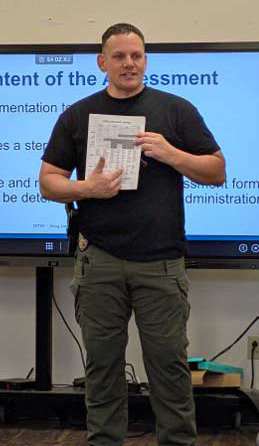
GRANTS, N.M. - Milan Police Chief Carl Ustupski recently led a comprehensive, two-day training program: Drug Impairment Training for Educational Professionals (DITEP).
The program is specifically designed to equip school administrators and healthcare professionals with the skills necessary to identify and address drug impairment among students. “The goal of the training and assessment process if not enforcement,” Chief Ustupski explained. “It is intervention—making sure that student is not having a medical issue, and ensuring the safety of the students, staff, and campus. We want to do everything we can to ensure a safe learning environment for all.”
A Two-Phase Curriculum
The training was divided into two distinct, specialized days to maximize its impact across different school departments.
Day 1 was open to anyone affiliated with a school, particularly high-level administrators. The curriculum covered general drug impairment, drugs in society, school policy procedures, alcohol overviews, and drug identification categories and their effects.
Day 2 focused on practical, medical assessments, making it ideal for school nurses and resource officers. Participants learned how to conduct eye examinations, check vital signs, administer divided attention tests, recognize poly-drug use, and navigate the assessment process, including protocol for contacting parents.
The Science of Intervention
Drawing from the national Drug Evaluation and Classification (DEC) Program, DITEP employs evaluation methods grounded strictly in medical and scientific research. While the course does not qualify school staff as official Drug Recognition Experts, it significantly enhances their competence and confidence in evaluating suspected abuse.
The training empowers school nurses to determine if a student’s impairment is a medical emergency or substance-related. If it is drug-related, staff can quickly identify the likely categories of drugs causing the issue. Detailed assessment forms were provided to help determine symptoms and narrow down the drug being used. By implementing this systematic approach, school typically see a decline in drug usage, fewer classroom disruptions, and a decrease in impaired driving incidents.
The Origins of DITEP
The inception of DITEP traces back to the 2003 National Survey on Drug Use and Health, which revealed alarming statistics about substance abuse and drunk driving across America. In response, states like Arizona, Kansas, and New York pioneered their own specialized school training programs. These regional efforts were later reinforced with the support of the International Association of Chiefs of Police and the National Highway Traffic Safety Administration to form the standardized national DITEP curriculum used today.
The Future in New Mexico
Despite its proven benefits, DITEP has not been widely offered in New Mexico for many years. However, Chief Ustupski is hopeful that “by next year, which will change and NM will have more instructors, and the course will be taught more frequently, if schools would like the training.”
“As always, the safety of our kids is of utmost importance,” Chief Ustupski affirmed. “We want to help them now so that when [they are] done with school, they can become productive members of our society. If we do nothing, then we are failing these kids and their futures!”