

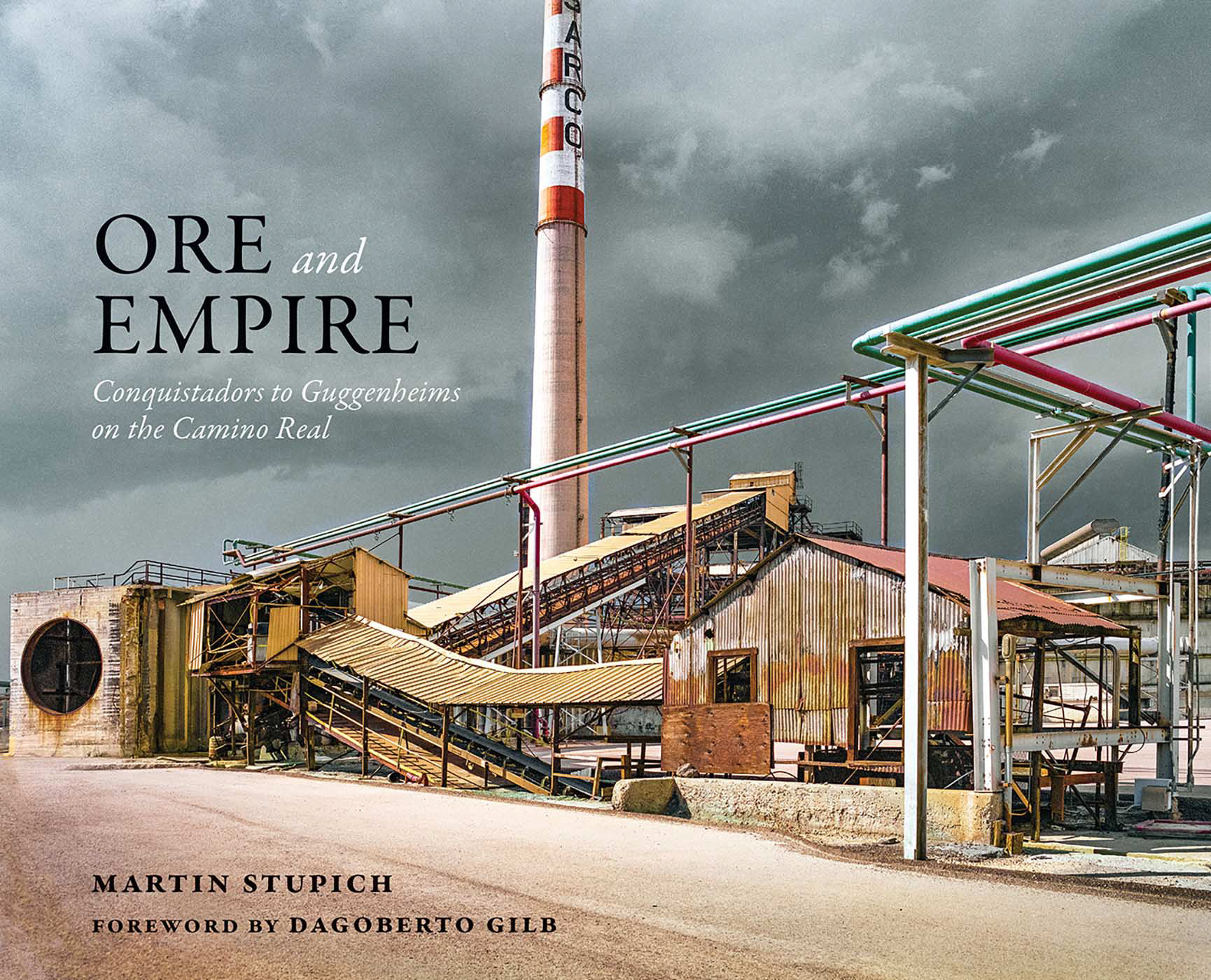
“Reading makes immigrants of us all. It takes us away from home. But more important, it finds homes for us everywhere,” Author Jean Rhys, 1890-1979, Exeter, United Kingdom This book focuses on two empires - sixteenth century Spain, which sent conquistadors to the New World searching for riches, and the powerful nineteenth- century Guggenheim mining and smelting industry.
Dagoberto Gilb, whose career includes working in high-rise construction sites for more than two decades, notes that the work sites “tore open the earth, pounded and scooped and discarded it. It was another vision being created . . .”
Gilb introduces four essays that expand our understanding of the history of extractive industries in the Americas. Betsy Fahlman, Michael Romero Taylor, Martin Stupich, and Toby Urovics offer insights into how photography captures human efforts to alter the natural world, the fruits of the Industrial Revolution, the history of El Paso del Norte, the industrial landscape of El Paso, Texas, and the longevity of engineered landscapes.
By 1519, the Spanish crown had issued licenses to its warrior-conquerers to pillage, exploit, baptize, and govern the civilizations of the lands they conquered. Their search for gold, silver, and other precious metals stretched from Cuba, situated where the Caribbean Sea meets the Atlantic Ocean and the Gulf of Mexico, into Mexico, then farther south into Peru in South America, and north as far as Colorado in the United States. But the conquistadors and those who came later searching for wealth were only following in the footsteps of miners from ancient civilizations.
Meyer Guggenheim, an immigrant from Switzerland, invested in two underperforming mines located in Bingham Canyon, Utah, in 1880. These mines were some of the first to implement a new technology for retrieving minerals. The process featured open-pit extraction instead of the standard method which for centuries had relied on tunneling into the ground. The resulting pit at the Bingham Canyon mines is now 3,970 feet deep. These mines near Leadville were the birth of the industrial corporation, M. Guggenheim Sons.
By 1899 ten mining and smelting companies had formed the American American Smelting and Refining Company (ASARCO) in El Paso, Texas, which the Guggenheim corporation purchased two years later. That industrial complex became one of the largest mining enterprises owned by M. Guggenheim Sons.
Located on the El Camino Real, the two-hundred acre ASARCO facility in El Paso sits on the banks of El Rio Bravo river. The river, now known as the Rio Grande, forms part of the southern border between Mexico and the United States.
The ASARCO site includes a small 1880s adobe structure that had served as its first smelter building. The facility boasted in 1966 that it had the world’s tallest concrete chimney. The chimney was an eighty-three-story-tall double- shelled concrete structure that towered above El Paso and Ciudad Juarez, Mexico. The giant chimney was deconstructed in 2013 as part of the efforts to remediate the ecological damages that had resulted from more than a century of smelting operations. The Guggenheim corporation’s business practices are just one example of human endeavors to control the natural world.
“The El Paso ASARCO smelter, America’s largest, rose where it did and succeeded so completely for so long because the natural setting and political landscape favored it and because ASARCO took prudent advantage of both,” explained photographer Stupich.
And farther south the Metropolitan Cathedral of the Assumption of the Most Blessed Virgin Mary into Heaven, Mexico City, Mexico anchors the south end of the Camino Real de Tierra Adintro which terminates 1,600 miles to the north in New Mexico.
“The [cathedral] building’s foundations rest upon, are literally made from, fragments of Aztec pyramids that predated by centuries the Spaniards’ arrival,” said Stupich.
Major developments in the Red Desert of southeastern Wyoming to harvest petroleum reserves, estimated at 150 trillion cubic-feet, began in the 1970s and continued through the 1980s. Photographs of a 9,300-acre Haliburton facility “documents what happens when a landscape collides with a twentieth- century enterprise, the shadows of emigrant trails crisscrossed by freshly laid gas pipelines,” wrote Urovics in his essay, The Old Topographics.
SIDEBAR:
Photographer Martin Stupich (1949 - ) was awarded his Master In Visual Arts, Georgia State University, Atlanta, in 1978. Numerous books, critical essays, and exhibition catalogs have featured Stupich's career, which spans more than forty years. His photography of industrial sites and landscapes across the United States and Asia has received international recognition.
One of his best known works is the Red Desert: History of a Place, which he co-authored with Canadian writer Annie Proulx. The book was a finalist for the 2008 Foreword Magazine Book of the Year Awards, Environmental Category.
The Red Desert: History of a Place documents attempts to harvest one of North America’s largest natural gas reservoirs. The Red Desert covers millions of acres of land located in a vast, high-altitude expanse in south-central Wyoming; it includes towns like Rock Springs, Rawlins, and Lander.
Rosanne Boyett
com