
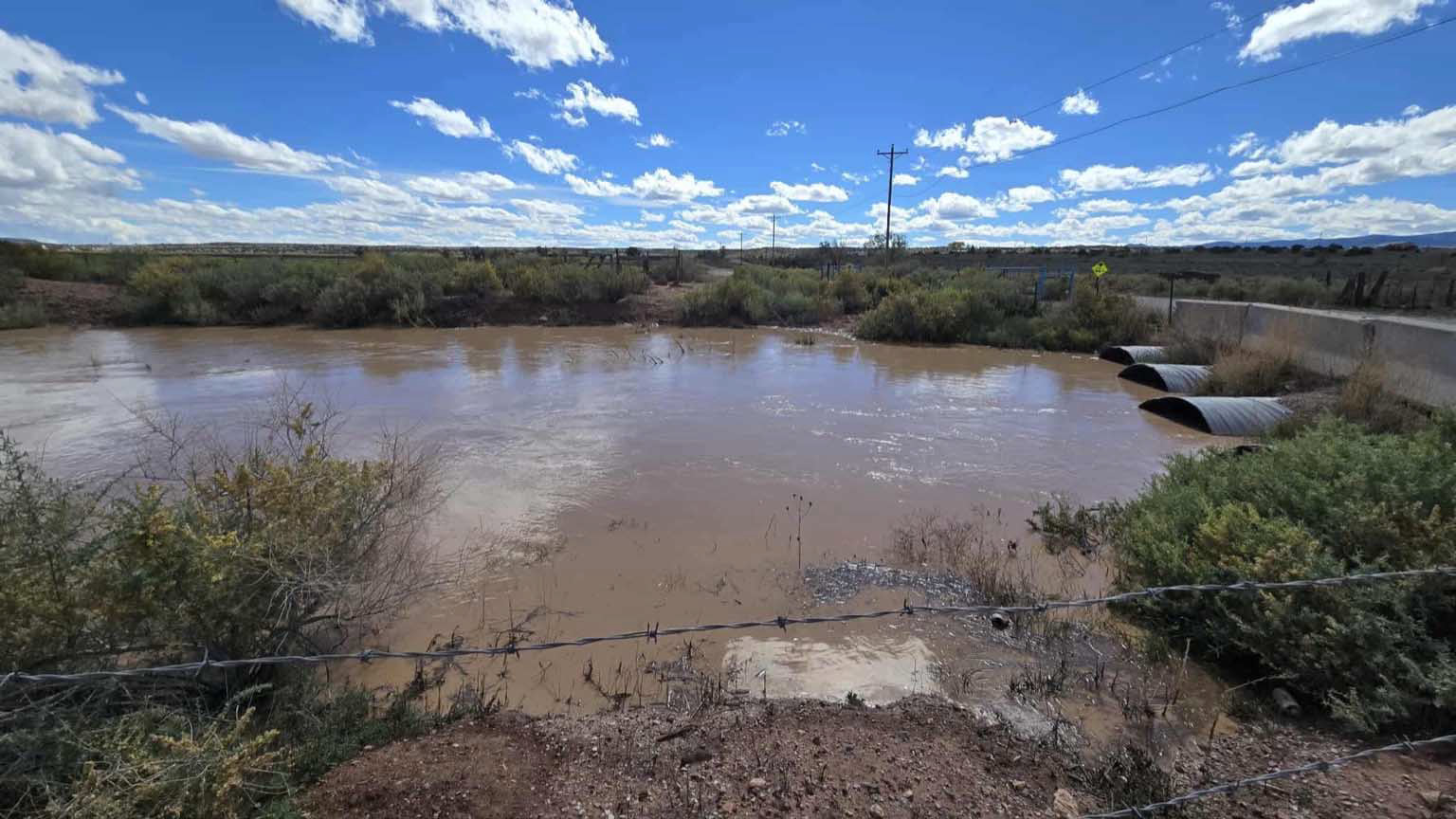
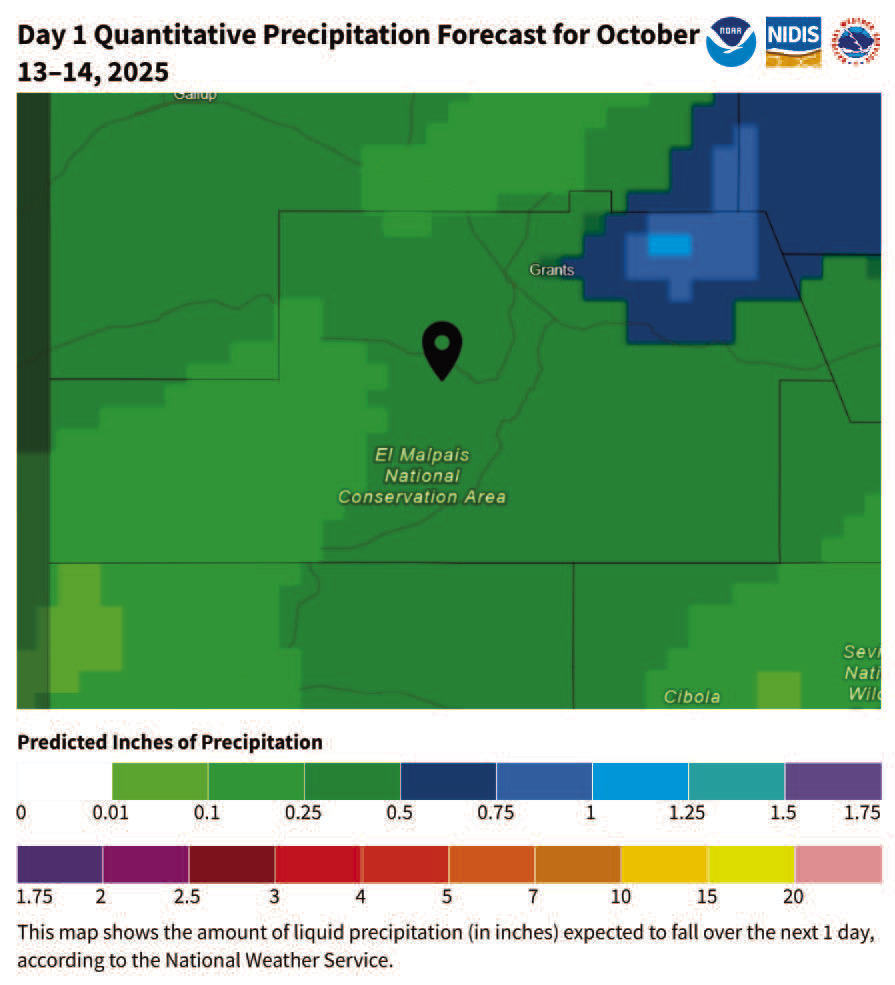
CIBOLA COUNTY, N.M. — A light to moderate wetting rain is forecast for the Grants–El Malpais area this week, with totals around 0.25 to 0.50 inches and locally higher amounts to the northeast, according to Drought.gov and the NWS Weather Prediction Center (updated Oct. 13). The moisture will help settle dust, dampen fine fuels, and briefly improve near-surface soil conditions at the start of the new water year, but it does not resolve broader deficits.
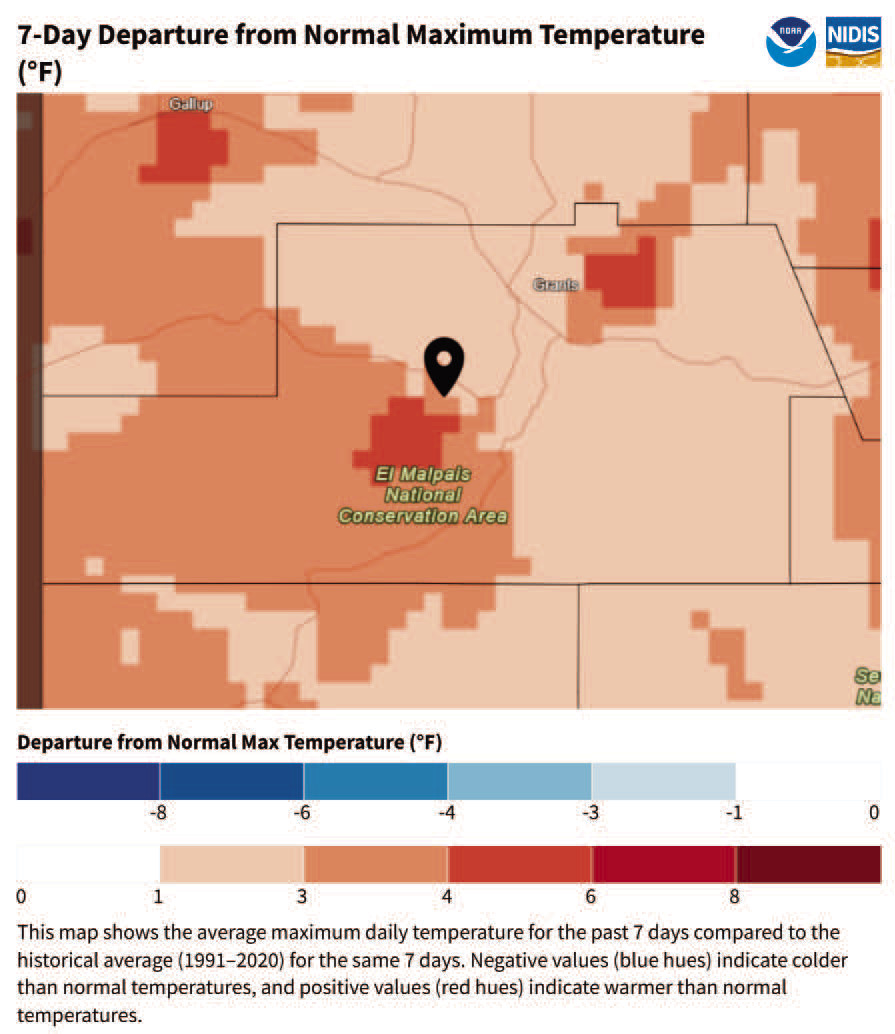
Temperature data through Oct. 10 show daytime highs running about 3°– 6°F above average near El Malpais. That warmth, combined with only spotty showers, sustained drying stress across rangelands and pasture even as cloud cover increased at times.
Current Drought Status As of the Oct. 7 U.S. Drought Monitor release, 100 percent of Cibola County is in drought. The county is split among Moderate (D1, 30.40 percent), Severe (D2, 35.06 percent), and Extreme (D3, 34.54 percent) categories, with no Exceptional (D4).
The county’s Drought Severity and Coverage Index (DSCI) stands at 304, reflecting both the breadth and intensity of conditions. By comparison, at the start of the calendar year (Dec. 31, 2024), more than half the county (56.94 percent) registered no drought (DSCI 44), underscoring how conditions have deteriorated through 2025.
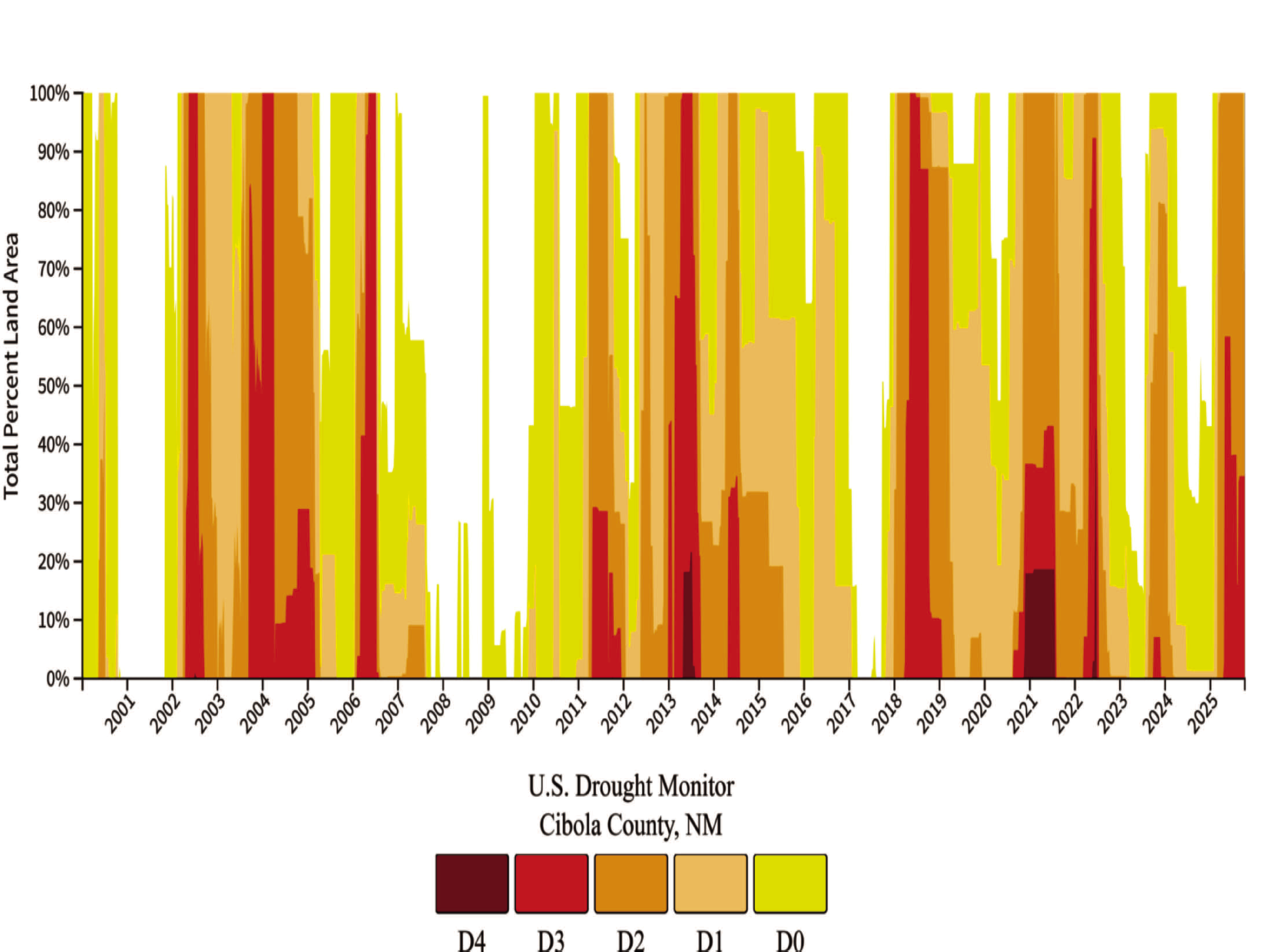
A long-view graphic of Cibola’s weekly drought status from 2000 through Oct. 13, 2025 shows frequent stretches in D2–D3 with occasional D4 of full or near-full recovery.
The current alignment— broad coverage and elevated intensity—is consistent with past multi-month dry runs.
Precipitation Deficits and Local Impacts
Cibola recorded its 35thdriest August in 131 years, about 0.76 inches below normal From January through August 2025, the county ranks 13th driest on record, running 3.13 inches below normal for the period.
Agricultural indicators mirror the map: an estimated 448 acres of hay and 30 acres of haylage are in drought (D1– D4), along with roughly 10,281 cattle and 3,026 sheep on stressed range, according to the US Department of Agriculture.
A quarter- to half-inch of rain is expected this week and should provide a short-term wetting of fine fuels and the top few inches of soil and may prompt a modest green-up where shade and aspect favor retention.
However, subsoil recharge and stock pond recovery require repeated rainfall events and cooler daytime highs to reduce evaporation. With the water year beginning Oct. 1, early-season storm frequency will be important in determining whether the county can chip away at deficits heading into late fall.
If additional systems follow in the next several weeks—and temperatures trend closer to seasonal norms—Cibola could begin to stabilize surface moisture before hard freezes and shorter days limit infiltration. Absent a pattern of follow-up precipitation, the county is likely to remain in a D2–D3-dominant profile into November.
Drought in 2025—and the Longer Arc
Cibola opened the calendar year in comparatively good shape—on December 31, 2024, a majority of the county (56.94 percent) showed no drought on the U.S. Drought Monitor, and the county’s Drought Severity and Coverage Index (DSCI) sat at 44.
By midsummer, the picture had flipped. As of July 8, 2025, 100 percent of the county was in drought, with all acres at least D2 (Severe) and roughly 38 percent in D3 (Extreme), pushing the DSCI to 338, one of the year’s highest readings. That deterioration reflects a spring and early-summer pattern of underperforming storms and persistent warmth that steadily drew moisture from soils, rangeland, and stock ponds.
Conditions have stabilized but remain serious this fall.
The latest monitor (October 7) keeps 100 percent of Cibola in drought, distributed across D1 (30.40 percent), D2 (35.06 percent), and D3 (34.54 percent), with a countywide DSCI of 304—unchanged from the September 30 snapshot.
August closed as the 35thdriest on record (-0.76 inches), and January–August ranks 13th-driest in 131 years (-3.13 inches from normal).
Those deficits are visible on the ground: an estimated 448 acres of hay and 30 acres of haylage are in drought, and roughly 10,281 cattle and 3,026 sheep are grazing stressed range that never fully recovered after spring.
Placed in historical context, the county’s long drought timeline—from the start of the U.S. Drought Monitor in 2000 through October 13, 2025—resembles a barcode of lean years punctuated by shorter reprieves. Cibola has spent frequent, extended stretches in D2–D3, with occasional D4 episodes, interspersed with white gaps when drought briefly cleared.
The current configuration— broad coverage with a large share in D2 and D3—fits that long-running pattern. It also underscores a familiar local reality: single storms can freshen the surface, but reversing multi-month deficits typically requires a sequence of autumn and early-winter systems paired with cooler daytime highs so moisture can infiltrate and hold.
In short, 2025 has tracked along Cibola’s historical tendency to “lean dry,” moving from a promising start to a markedly drier midyear and into a stubborn D2–D3 profile this fall. Early-season rains in October help, but the county’s path out of drought will depend on repeated, soaking events as the new water year gets underway.