
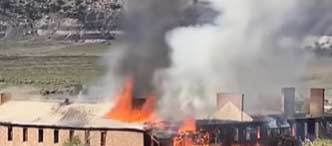
Former Army barracks and boarding-school dormitory lost as monsoon storms continue across western New Mexico
FORT WINGATE, N.M. – A lightningsparked fire destroyed a long-vacant historic building at Fort Wingate over the weekend, reducing much of the former Army barracks and boarding- school dormitory to its stone exterior walls.
McKinley County fire crews were dispatched to Fort Wingate at approximately 4 p.m. Saturday. Officials said the fire began in the roof and was believed to have been caused by lightning during a period of active monsoon thunderstorms across western New Mexico.
Because of the building’s deteriorating condition, firefighters remained outside and used a defensive strategy rather than entering the structure. Crews worked into the night to keep flames from reaching nearby buildings, bringing the fire under control shortly after 1 a.m. Sunday.
The building was considered a total loss. Its interior was gutted, leaving only portions of its stone walls standing.
No information concerning injuries was immediately provided.
The destruction represents the loss of another physical piece of Fort Wingate’s complicated history – a history encompassing military service, federal Indian education, Native American resilience and, more recently, renewed missile-testing activity.
The building reportedly was constructed during Fort Wingate’s early military period and initially served as Army barracks. It was later used as a dormitory for Native American students attending the federal school at Fort Wingate. The structure had been vacant and fenced off for approximately two decades before the fire.
A Site Carrying Several Histories
Fort Wingate is located east of Gallup in McKinley County, approximately 53 miles west of Grants. The land has long held cultural and spiritual importance for the Navajo Nation and Pueblo of Zuni, whose connections to the area predate the arrival of the U.S. military.
The first military installation in the area was established in 1860. Fort Wingate was reestablished under its current name in 1868 and later served several military purposes, including as an explosives depot and a Cold War missile-launch site.
The site was also connected to one of the most consequential chapters in Native American military history. On May 4, 1942, the original 29 Navajo Code Talkers took their military oaths at Fort Wingate before beginning the service that would help secure American communications in the Pacific during World War II.
Fort Wingate later operated as a Bureau of Indian Affairs school. In 2025, the New Mexico Historic Preservation Division expanded the Fort Wingate Historic District to recognize buildings and areas associated with its reuse as an Indian boarding school from 1926 to 2009.
That designation broadened the historical record beyond the fort’s military years to include classrooms, dormitories, administrative offices, cottages, a cafeteria and a gymnasium constructed during the school era.
Former Gallup City Councilor Michael Schaaf said the destroyed building had not been occupied for many years but remained historically significant.
“Good, bad, it’s still history, and it’s a shame that we’ve lost it,” Schaaf said.
Community members had previously discussed preserving portions of Fort Wingate or establishing a museum to interpret the site’s military and Native American history. Following the fire, residents renewed calls for the remains to be secured, cleaned and preserved in consultation with the Navajo Nation.
Fire Follows Unsettled Monsoon Weather
The fire occurred amid a turbulent stretch of summer weather across McKinley and Cibola counties.
Drought.gov data valid July 25 show much of the Fort Wingate region received approximately one-half inch to 2 inches of precipitation during the preceding seven days, with heavier pockets elsewhere in western New Mexico. Despite the rain, average daily maximum temperatures remained generally in the 80s across much of the region during the same period.
Those conditions illustrate the uneven nature of the monsoon: thunderstorms may produce locally heavy rain and flash flooding while simultaneously creating lightning capable of igniting structures or vegetation in places receiving little rainfall.
The National Weather Service forecasts additional rounds of afternoon and evening thunderstorms this week. A Flood Watch was in effect Tuesday afternoon and evening for portions of western New Mexico, with storms capable of producing heavier rainfall in isolated locations.
For the Prewitt area, near Fort Wingate, forecasters called for scattered thunderstorms Tuesday through Thursday, with daytime temperatures ranging from approximately 90 to 92 degrees. Isolated storms remained possible into the weekend as temperatures climbed into the lower to middle 90s.
The continued storm pattern means lightning, sudden runoff and rapidly changing road conditions will remain concerns even where skies appear clear earlier in the day.
The fire did not erase Fort Wingate’s history, but it removed one of the structures through which that history could still be physically seen.