
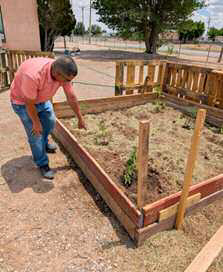
![“My goal is [to] get the community involved… they can take [some vegetables] home to their family… I’m even willing to go help somebody else if they come help me… You [help] me, I [help] you.” Carlos Garcia said, expressing the need for volunteers “If this keeps going, it’s going to benefit everybody.” Amerika Rougemont - CC](/sites/cibolacitizen.com/files/1e3f734ab6_Ar00103003.jpg)
GRANTS, NM - Carlos Garcia, the cook for St Teresa School, has recently planted a garden outside the school, not only for the school, but for the community as well, stating “My goal is [to] get the community involved… and they can [pick the vegetables
Amerika Rougemont, Reporter
and] take it home to their family.”
Emphasizing his goal to get away from eating processed food and start pushing good food on schools he explained “The food program right now is highly pushing scratch to table. Instead of getting a lot of packaged food with a lot of stuff in it, [I would] rather make it myself.”
Having always bought the vegetables
Amerika Rougemont - CC
The plants currently being grown at St Teresa School include the tomatoes: big beef, golden, and Cherokee purple, as well as chili, squash, pumpkins, watermelon, cucumbers, and the possible additions in the future: corn and fruit trees. Carlos Garcia stated “Later we’ll have more stuff… I’m thinking whatever wants to grow, let it grow.”
from somewhere else, knowing there were things added that shouldn’t have been, he realized it would be a good idea for the school to grow their own food, and so, he began it, and even expressed his enthusiasm “I’m really pumped about it.”
Starting the Garden
Garcia is making his own compost for the garden, using the cardboard that is best for this endeavor, as well as having earth worms and red wiggler worms in the ground to turn the cardboard into compost within a matter of weeks. This way it is beneficial, as it helps the school to not waste compost goods and it prevents the harm that comes with throwing it away.
“It is going to be [safer] because there is nothing going in this dirt other than some manure and regular dirt… There is nothing else going into the soil to hurt the plants and to hurt us.”
Some of the soil was bought for $400, while more was donated to the school. The wood used to make the plant beds was also donated, and the plants were bought from the local farmer’s market.
The main vegetables in the garden are tomatoes, due to their nutritional value and rich source of vitamin B12, and chili, because we are New Mexicans. Other vegetables in the garden include squash, pumpkins, watermelon, and cucumbers. “Later we will have more stuff… I am thinking whatever wants to grow, let it grow.” Garcia stated, determined to keep all of it natural and without preservatives or any other harmful additions.
Educational Opportunity
The teachers at St Teresa school will be instructing the students about plants and the benefits of eating them, helping them to understand the significance of the garden. The students will be able to remove the weeds, water the plants, and more, with the possibility of being a home ec class. “My goal,” Garcia informed “is to get these kids on a mission of growing their own food and eating off of the land.”
One of his future plans is to make bread ovens so the seventh and eighth graders will be able to learn how to make bread, pizza, and more, truly helping them prepare for adulthood and to make better eating choices, as Garcia had stated “My big thing is to get the kids eating healthier [and making] better choices on what they put in their body. So, my goal is for them to eat good.”
Additionally, there are gardening classes at 4H and Future Foundation.
Future Plans
More of his plans for the future, other than the bread ovens, include producing corn, which he believes will be a great snack. Fruit trees, such as apple or plums, produce a variety of options such as making pies, jams, and more.
He is also considering getting a cow so they can have fresh meat that will not have other things added.
A greenhouse, which will protect the plants from insects, is currently a thought. Continental Divide has a $5,000 grant which they will install the greenhouse.
Opportunity for the Community
As of the 12th, it was only Garcia and a few volunteers cultivating the garden. He expressed his need for volunteers by saying “I am even willing to go help somebody else if they come help me… You [help me, I [help] you.”
Those who volunteer will be able to take some of the crop’s home and be part of something that “if this keeps going, it’s going to benefit everybody.” If this garden continues to grow, he intends for it to be a community garden, so everyone will not have to rely on vegetables with preservatives and more, they have a choice to eat something that is actually good for them.