
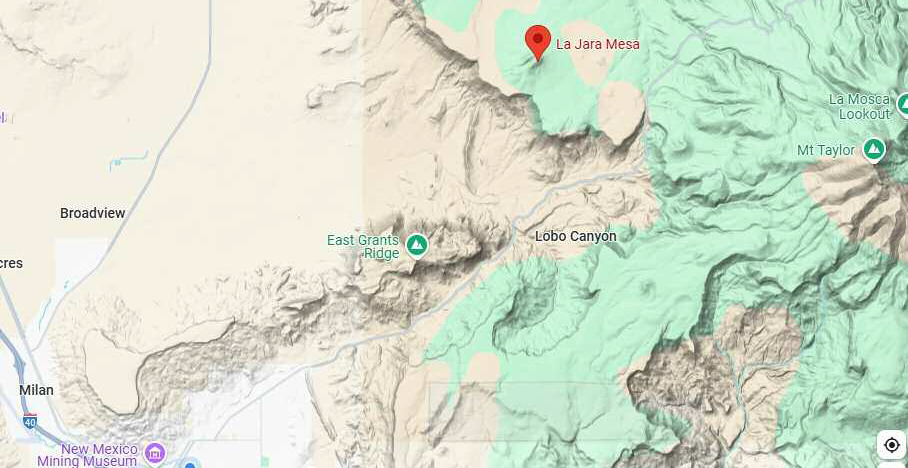
GRANTS, N.M. — A sweeping series of executive orders signed by President Donald Trump on May 23 aims to fast-track uranium mining across the United States, raising serious questions about the future of two long-dormant mines near Mount Taylor the White House sees as “priority projects”.
Among the 20 energy and mineral projects recently identified as national priorities by a White House infrastructure agency are Roca Honda and La Jara Mesa, both uranium mines located near Grants, New Mexico, on the beautiful Mount Taylor.
The federal government has announced it will attempt to accelerate uranium production in Cibola County — a region still grappling with the legacy of the Cold War-era mining boom.
The federal actions follow Trump’s March 20 executive order declaring uranium “mission critical” for U.S. energy independence and national security. On May 23, four additional executive orders further emphasized that stance, calling for the revitalization of the domestic nuclear fuel supply chain, deregulation of the Nuclear Regulatory Commission (NRC), and the deployment of advanced nuclear reactor technologies on military installations and Department of Energy sites.
The directives would also speed up licensing, recycling, and reprocessing of spent nuclear fuel, along with export support for American uranium technologies.
Under new rules, permitting will be cut down to 14-days of evaluation.
Despite federal efforts, New Mexico state officials say their permitting process remains unchanged. DJ Ennis, program manager for the Mining Act Reclamation Program at the New Mexico Energy, Minerals and Natural Resources Department (EMNRD), confirmed to Source New Mexico that even if federal reviews are expedited, the state maintains full authority to independently review mine proposals under the 1993 New Mexico Mining Act.
“The feds are going to do what the feds are going to do,” Ennis said. “But if [federal permitting] is not on the same pace, the default becomes the state’s permitting process, and we have a ro- bust permitting process.”
Ennis said that if a company attempted to break ground without state approval, the department could issue daily fines and potentially involve the New Mexico State Police to enforce the law and prevent uranium mining from restarting without state permission.
Sacred Site Protections
Mount Taylor has been designated a Traditional Cultural Property (TCP) since 2014 by the New Mexico Supreme Court. The designation, supported by several Indigenous tribes and pueblos, recognizes the mountain as a sacred landscape and requires consultation during any project review process.
However, the TCP designation does not explicitly prohibit mining, and its role in the permitting process has yet to be tested. “The intersection of those two is a difficult question to answer,” Ennis said. “I don’t know that we’ll know until we get to the end of the process.”
Eric Jantz, an attorney with the New Mexico Environmental Law Center, said the state’s authority provides some protection, but he warned that expedited federal processes could trigger litigation. “If the Forest Service either ignores its obligations under NEPA [National Environmental Policy Act] because of this executive order or its own regulations, litigation will probably ensue,” he said.
Navajo Nation Transport Agreement Raises Alarms
Energy Fuels Inc., the company behind the proposed Roca Honda uranium mine, has already entered into a confidential agreement with the Navajo Nation to transport uranium ore from its Pinyon Plains Mine in Arizona through the reservation to a mill in White Mesa, Utah.
The agreement includes provisions for cleanup of abandoned mines and compensation per pound of uranium transported. Energy Fuels has indicated that the agreement also anticipates future ore transport from Roca Honda, though the Navajo Nation maintains that no specific roads have been approved.
Stephen Etsitty, director of the Navajo Nation Environmental Protection Agency, estimated that Roca Honda could generate 50 to 60 truckloads of ore per day if developed. He said that while the Nation has not endorsed the project, the agreement provides a “framework” for future negotiations and cleanup obligations.
No Comment Available
from Governor’s Office
Upon hearing of state police on Mount Taylor being used to prevent uranium mining, the Citizen reached out to the governor’s office.
As of press time, the governor’s office had not provided comment. A representative from the Department of Finance and Administration said the entire governor’s communications staff was out sick, and they would attempt to provide information at a later date.
The National Context
The push to accelerate uranium mining comes amid global efforts to expand nuclear power.
According to the 2024 Red Book, a joint report from the Nuclear Energy Agency and International Atomic Energy Agency, current uranium reserves will last through the 2080s under high-growth scenarios, but substantial investments in exploration and mining are required immediately.
Global uranium production remains concentrated in just a few countries, with Kazakhstan, Canada, and Australia leading the market. The report also noted that the COVID-19 pandemic caused a slowdown in uranium mining investment, but spending rose to $840 million in 2023.
Meanwhile, American corporations like Microsoft and Amazon have begun investing in nuclear power as a reliable energy source for artificial intelligence data centers, further increasing demand for uranium.
What Comes Next for Cibola
Both La Jara Mesa and Roca Honda have been in permitting limbo for more than a decade.
Now, under the Trump administration’s orders, they have been elevated to priority status by the U.S. Forest Service, which manages Mount Taylor and surrounding areas. Yet despite the federal push, actual mining cannot legally commence without state approval.
Public health researchers, including longtime uranium critic Christopher Shuey, say any restart will take years, giving communities time to engage. “A lot of these folks have lived through the 80 years of the uranium legacy,” Shuey said. “They’ve learned across generations of the impacts of mining.”
Editor’s Note: The Cibola Citizen will continue to seek responses from the Governor’s Office and update readers as new information becomes available.