
CIBOLA COUNTY, N.M. – In a county where economic development conversations often focus on jobs, wages and business growth, housing remains one of the clearest measures of local stability.
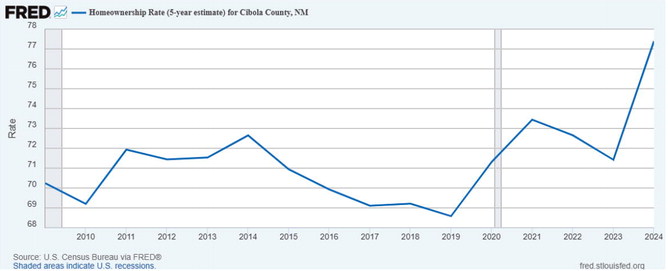
Cibola County continues to stand out as a largely homeowner county. According to U.S. Census Bureau Quick-Facts, the county’s owneroccupied housing unit rate for 2020–2024 was 76.1%.
The median value of owner-occupied housing units was listed at $125,400, while median gross rent was $759.
Those numbers help show why housing is an important part of the county’s broader economic picture. For many families, homeownership represents more than a roof overhead. It can mean long-term investment, community stability and a stronger connection to place.
Federal Reserve Economic Data, using U.S. Census Bureau information, shows Cibola County’s homeownership rate has moved up and down over the past decade and a half. The rate declined during parts of the 2010s before rising again in more recent estimates. By 2024, the FRED graph showed a sharp increase in the county’s homeownership rate.
That trend points to one of Cibola County’s strengths: many residents are rooted here.
At the same time, high homeownership does not mean housing is without pressure.
Another FRED graph tracking burdened households in Cibola County shows that the share of households facing housing cost burdens has increased since 2020. In broad terms, according to FRED, burdened household is one where housing costs take up a large share of income, leaving less money available for other needs such as food, transportation, health care, child care and savings.
Homeownership remains high, but affordability still matters.
The county’s median selected monthly owner costs were $1,264 for homeowners with a mortgage and $308 for homeowners without a mortgage, according to Census QuickFacts for 2020–2024. Those numbers show a major difference between households still paying on a home and those who own their homes outright.
Housing also connects directly to workforce development. A community can attract new jobs and support existing employers only if workers can afford to live nearby. Stable housing helps families stay connected to local schools, businesses, churches, health care providers and community organizations.
Cibola County had an estimated population of 26,807 as of July 1, 2025, according to Census population estimates. That was down slightly from the April 1, 2020 estimates base of 27,046, but up from the July 1, 2024 estimate of 26,686.
The county also had 8,503 households during the 2020–2024 period, with an average of 2.98 persons per household. Each household represents a local economic unit: people buying groceries, paying utilities, commuting to work, supporting schools and participating in civic life.
As Cibola County looks toward future economic development, housing will remain part of the foundation. Jobs, education and business growth all matter, but so does the ability of local families to stay housed, stay rooted and build a future here.