CIBOLA COUNTY, N.M. – Childhood poverty is one of the clearest measures of economic strain in Cibola County, and one of the strongest warnings about the county’s future workforce, schools and family stability.
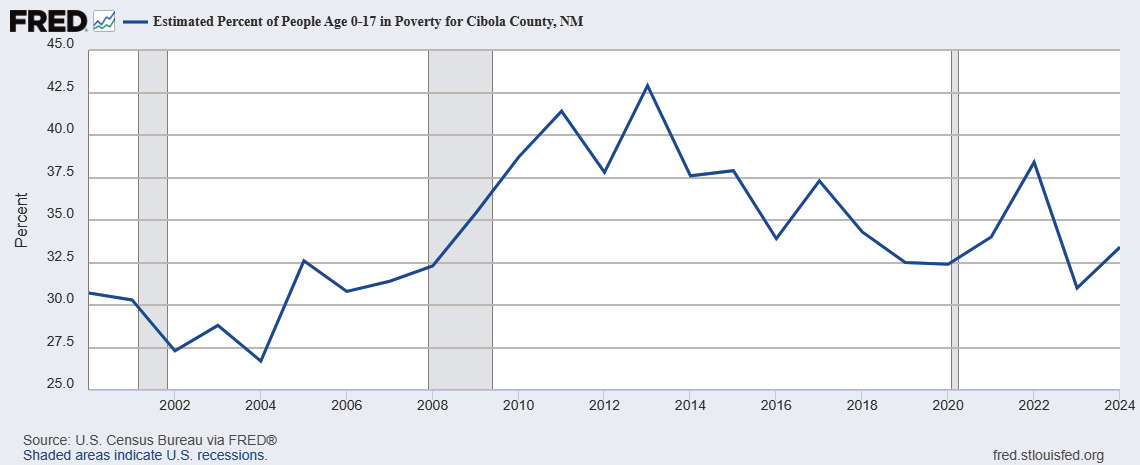
Recent US Census Bureau and Kids Count data show roughly 41% children under the age of 18 in Cibola County live in poverty, a rate far higher than the county’s overall poverty rate and well above state and national child poverty levels. For a county working to strengthen its economy, attract investment and prepare young people for future jobs, the numbers point to a basic reality: the effects of economic development begin long before adulthood.
According to the New Mexico Kids Count 2025 report, Cibola County had about 6,310 children ages 0 to 17 in the 2019–2023 data period. The same report listed the county’s child-under-18 poverty rate at 41%, compared with 28% for residents-ofall- ages.
For contrast, Cibola County stands at 41%, higher than the statewide child poverty rate of 25% and the national rate of 16% reported in the Kids Count material.
The U.S. Census Bureau’s 2024 American Community Survey fiveyear estimates also show the depth of the challenge. The Census estimate placed poverty among Cibola County residents under age 18 at 41.6%, while poverty among all county residents was estimated at 28.4%. The same ACS material estimated Cibola County’s median household income at $50,759, compared with $67,816 statewide.
For families, the numbers describe more than income.
Poverty can shape whether a child has reliable food, stable housing, transportation, health care, child care, internet access and the support needed to succeed in school. Over time, those pressures can also affect the local workforce.
The Annie E. Casey Foundation and New Mexico Kids Count frame child well-being through several connected areas, including economic wellbeing, education, health, and family and community. The 2025 Kids Count material notes that poverty measured only by income does not fully capture the resources families need, or the role of public programs and tax credits in reducing hardship.
In Cibola County, the pressure shows up across several local indicators.
The Kids Count 2025 report also showed that only 38% of Cibola County families with children had all parents in secure employment, compared with 66% statewide and 70% nationally.
Equipping the Future
Cibola Communities Economic Development Foundation Executive Director Cooper Jones said addressing child poverty and workforce readiness are connected challenges.
“Economic development is the most effective tool against child poverty,” Jones said in an email. “We are tackling the ‘under-equipped’ workforce issue by aligning classroom curriculum directly with local industry needs.”
Jones said CCEDF is working with the local school district and New Mexico State University to build clear “Pathways” from graduation into higher-paying local jobs.
Active pathways include nursing and welding. Pathways in development include business, broadcasting, heavy equipment operation, commercial driver’s licensing and mining or uranium sciences.
“The future of Cibola County depends on a workforce that is ready on day one,” Jones said. “We are no longer just hoping for jobs; we are building the people to fill them.”
The pathway approach reflects a broader economic reality for rural communities: reducing poverty is not only about attracting employers, but also about preparing local residents to compete for the jobs that already exist or may come next.
For Cibola County students, those pathways could help connect classroom learning to local opportunity. For families, they could provide a clearer route from school to stable work. For employers, they could help address workforce shortages by preparing students for specific local industries before they leave high school or college.
The challenge is that poverty can begin affecting children long before they reach graduation.
The New Mexico Children’s Cabinet 2025 Annual Report emphasizes early childhood supports, health services, literacy, home visiting, child care and family income as part of the state’s broader effort to improve child well-being. The report notes that state spending connected to children and families has increased across several outcome areas since fiscal year 2019, including education, health and family support.
Statewide, New Mexico has expanded programs such as PreK, home visiting, child care assistance, adult education, tax credits and Medicaid- related family supports. The Children’s Cabinet report also highlighted work connected to maternal health services in rural communities, including Cibola County, and described child care, home visiting and family support programs as part of the state’s strategy to improve long-term outcomes.
More directly, the Grants-Milan International Rotary Club works with the schools to identify students in particular need of food. The local club is made up of volunteers. They purchase food and stock student backpacks with nonperishable food items for the weekends.
Those programs matter locally because childhood poverty is rarely caused by one problem. A parent may need training but lack child care. A student may be capable but struggle with housing instability. A family may have work but still face food insecurity, transportation costs or medical needs. A grandparent raising grandchildren may need legal, financial and social support.
The long-term stakes are high.
The Annie E. Casey Foundation reports that children growing up in poverty are more likely to face barriers in school, health and adulthood.
For Cibola County, the childhood poverty rate is not just a statistic about children today. It is a measure of the county’s future workforce, future families and future economy.