
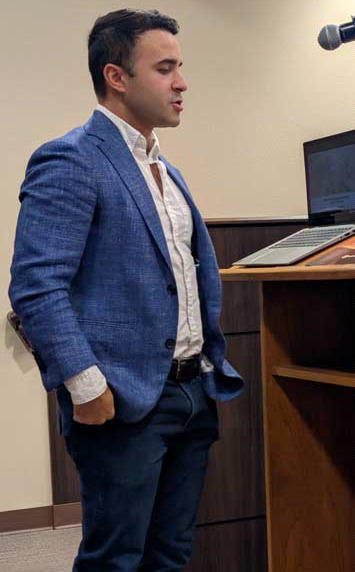
GRANTS, N.M. - The July 23 County Commission meeting had Director of Regulatory Affairs at Grants Energy, Daria Sayan, present the strategic importance of the Grants mineral belt and supporting IN-SITU recovery.
Sayan explained that as the Untied States looks for reliable, 24/7 carbon-free energy to power rising sectors like artificial intelligence, electronic vehicles, and heavy industrial activities, the need for domestic uranium production is coming to the forefront. “The U.S. [currently] imports 99% of its uranium [from foreign sources],” Sayan said. To address this demand a new project proposal has been put forward by Grants Energy, a well-funded, technologically advanced company with a deep background in groundwater restoration, including extensive experience reclaiming uranium mines in Germany through its research lab.
The project is being led by Grants Energy, which is the same corporation as Rio Grande Resources. It focuses on the initial stages of uranium production-including well drilling, processing, and yellowcake drum preparationacross a five-square-mile area in Cibola and McKinley counties. Notably, the company has made it clear that the project will take place entirely on private ranch land, separate from Mount Taylor.
A Pivot from Conventional Mining to ISR
Uranium was originally discovered in the proposed project area back in the 1960s, leading Gulf Mineral Resources to invest billions of dollars to establish an underground, conventional mine at Mount Taylor. Production ultimately stopped in the 1980s due to economic issues. Chevron later acquired and sold the resource to Rio Grande Resources in 1991.
By 2018, Rio Grande Resources held all the necessary active mining permits to legally resume conventional operations. However, the company chose to start from scratch. In 2019, they began the permanent closure of the conventional mine infrastructure, spending tens of millions of dollars without taxpayer support to remove head frame, fill in ponds, and dismantle buildings.
Now, the company is pursuing an In-Situ Recovery (ISR) project instead. Unlike conventional mining, ISR uses an underground well field to dissolve and extract uranium directly from sandstone, generating zero curve railing piles and creating a much smaller environmental footprint. Sayan said, “The one thing I ask you to think about during this presentation is if there’s a way to safely extract uranium from the ground, produce jobs, and generate tax revenue for the county and state. Should we do it?… If it’s safe, environmentally friendly, sustainable, and has the potential to be the future for the county.”
Prioritizing Risks and Water Safety
The debate surrounding the project hinges heavily on a critical evaluation of its risks, water usage, and longterm sustainability. Sayan dedicated a significant portion of his presentation to these exact concerns, acknowledging that community trust cannot be built without addressing environmental impacts transparently.
The uranium ore body sits more than 3,000 feet beneath the surface—a depth he compared to two Empire State buildings stacked on top of each other. This extreme depth provides a natural geological barrier. Local drinking and irrigation water is drawn from a shallow aquifer about 800 feet deep, leaving over 2,000 feet of natural confinement between community water and the production zone.
Furthermore, the groundwater inside the deep ore body is naturally radioactive, filled with radon, radium, gross alpha, and gross beta, making it already completely unsafe to drink. The ISR process involves drilling wells into this deep formation, adding oxygen and bicarbonate to dissolve the uranium, and pumping the liquid to a central processing plant. During operations, 99% of the water taken out is immediately recirculated back underground.
The vast majority of the net water consumed by the project is actually used later during groundwater restoration. The project proposes a maximum water usage of 2,100 acre-feet per year, drawn primary from the deep uranium aquifer. This volume is comparable to a large pecan farm or a semiconductor plant, but represents a minuscule 0.0001% of the enormous regional aquifer, which spans all the way into Colorado. Because this deep water requires highly expensive wells to access, it does not compete with cheaper, shallower drinking water.
Accountability and Environmental Controls
To ensure water containment and prevent environmental incidents, the company uses advanced modeling techniques and propriety software built on 25 years of accident-free operations at their sister site, Heathgate, in South Australia.
The primary defense mechanism is a monitoring well ring placed completely around the project area like a fence. Transducters track real time pressure readings and chemistry samples, giving operators advanced notice to resolve any water migration issues before fluids can exit the permitted boundary.
Once extraction is complete, groundwater restoration begins. The company uses reverse osmosis to purify the water, retiring it underground repeatedly until it matches its pre-mining baseline state. However, Sayan explained that 25% of the water entering the reverse osmosis system becomes concentrated liquid waste. The project plans to dispose of this waste via a deep disposal well drilled 7,000 feet underground, far below the surface. Regulators, not the company, will mandate the strict level of restoration required and determine the final acceptable water quality parameters.
Local Staffing and Tribal Partnerships
According to Sayan, the initial phase of the project is expected to create 200 direct, long-term jobs over a 30-year operational lifespan, producing 6 million pounds of primary mineral annually, alongside potential secondary molybdenum production.
Public outreach began in November 2024, and the company has already started hiring for Grants-based positions, including geologists and a hydrologist. They are currently seeking a chemical engineer with process planning experience. Rather than importing outside talent, the staffing plan focused on developing local know-how by transferring expertise from South Australia and proving structured mentorship from senior experts.
To minimize surface disturbance even further, the project plans to combine traditional vertical ISR wells with horizontal drilling technology. This advancement reduces the total number of required surface wells by 95%, meaning a single horizontal well can replace up to 20 vertical wells.
Recognizing the disproportionate impact that historic mining had on local native communities, Sayan explained that the company is actively presenting to the tribal councils of Laguna and Acoma to build trust through direct consultation. They are creating a multi-pillar community benefits plan that focus on water resource transfers, technology sharing, cultural resource managements, and education and jobs. A formal proposal outlines the transfer of water resource to the Laguna tribe, with a tailored proposal being prepared for Acoma. The company is also transferring advanced water filtration and purification technology and partnering with the tribes to procure cultural assets, potentially employing tribal cultural monitors directly onsite to ensure respectful land use. Additionally, they are investing in local STEAM education and structured workforce training programs.
While ISR is a new technology for New Mexico, Sayan said it has already been implemented and embraced in states like Texas, Wyoming, and Nebraska. To support its environmental safety claims, the company has funded independent research at New Mexico Tech and Los Alamos National Laboratory. The company aims to submit its formal permit applications late this year or early next year.