

“Books don't just go with you. They take you where you’ve never been.”
Anonymous
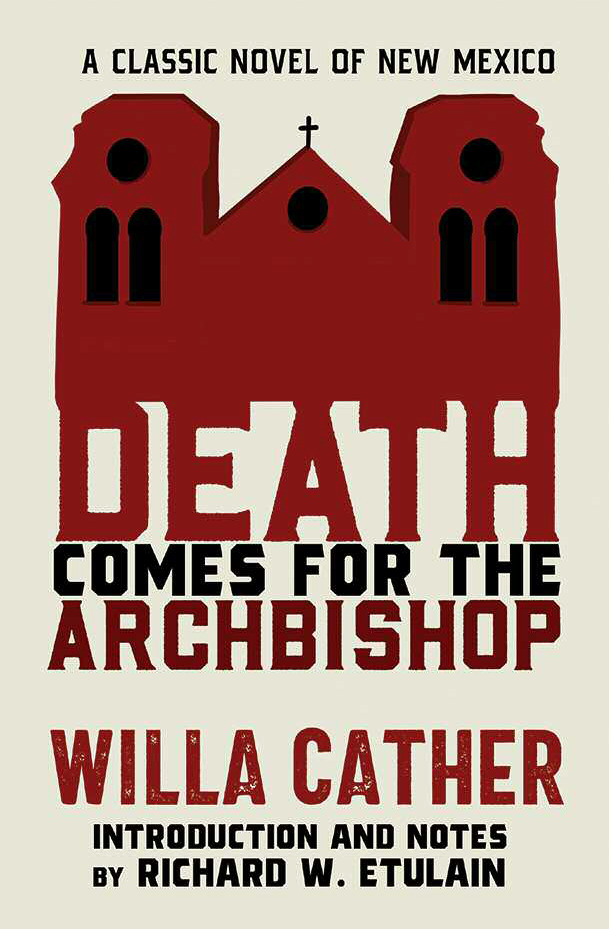
Willa Cather was immediately fascinated with the New Mexico landscape during her first visit in 1912. She returned several times to learn more about the interactions between the Native American, Hispanic, and European cultures. Those trips inspired her to write the timeless classic “Death Comes for the Archbishop.”
The author’s vivid descriptions entice the reader to imagine life in New Mexico during the latter half of the 19th century. (New Mexico became a U.S. state in 1912.)
The story is based on the life of Jean-Baptiste Lamy, a French-American Roman Catholic prelate who served as the first Archbishop of Santa Fe.
Mexico had ceded the region, which included what is now known as the state of New Mexico, to the U.S. as part of the 1850 Treaty of Guadalupe Hidalgo. The Roman Catholic Church designated New Mexico as an “Apostolic Vicarate” shortly after the treaty was ratified.
Cather traces the lives of two French priests, Father Jean Marie Latour and Vicar Joseph Vaillant, during four decades of their religious service. The newly ordained priests eagerly left their homeland and accepted the challenges of working in an Ohio parish.
Latour was appointed Apostolic Vicar for the Territory of New Mexico in 1851 and Vicar Vaillant became his lifelong assistant. The verdant terrain of Ohio soon became a vague memory for the two missionaries as they endured months of arduous travel by steamboat and on horseback before reaching Santa Fe.
“The very floor of the world is cracked open into countless canyons and arroyos. There are no roads, canals or navigable rivers and travelers must rely on pack mules for transport. Death by thirst or from Indian massacres are constant threats to any Europeans who venture into this harsh place,” wrote Cather.
Latour and Vaillant discovered that the people of the “Apostolic Vicarate” were American by law but Mexican and Native American in custom and belief.
Latour lived his religious beliefs by gently sharing his faith while adapting to living an unforgiving landscape, confronting openly rebellious priests, and facing personal loneliness.
For more than three decades, under the guidance of Archbishop Latour, Vaillant traveled to communities scattered across New Mexico and Arizona. Riding his favorite mule Contento, he offered religious services and holy sacraments to the people who lived in these rural settlements.
Father Vaillant also traveled to Mexico to negotiate with Catholic bishops about the Gadsden Purchase. The United States had purchased southern Arizona and southwestern New Mexico from Mexico with the 1854 Treaty of Mesilla.
Vaillant dedicated his final years as a missionary to the gold miners in the camps that later became the city of Denver, Colorado.
Latour was good friends with many Navajo and often traveled to their communities during his later years. He admired their religious beliefs that emphasized a sense of connectedness to the natural world.
“Father Latour found Eusabio seated beside his doorway, singing in the Navajo language and beating softly on one end of his long drum,” wrote Cather. “Before him two very little Indian boys, about four and five years old, were dancing to the music, on the hard beaten ground. Two women, Eusabio’s wife and sister, looked on from the deep twilight of the hut.”
After decades of religious service, Latour retired to a small homestead near Santa Fe. He planted an extensive orchard and trained new missionary priests when they arrived from France.
Latour fulfilled a lifelong dream when he hired the architects who designed the Romanesque Revival-style church that was built around La Parroquia, an adobe church built on the same site as an older church that was destroyed in the Pueblo Revolt of 1680. The European- style cathedral symbolizes the missionary’s efforts to reshape New Mexico’s Catholicism, according to historians.
“I have lived to see two great wrongs righted; I have seen the end of Black slavery, and I have seen the Navajos restored to their own country,” said the archbishop toward the end of his life.
Sidebar: Willa Sibert Cather (1873-1947), American author, grew up in Nebraska and worked in New York City as an adult. Cather wrote 16 novels and was awarded the 1923 Pulitzer Prize for “One of Ours,” which tells the story of the life of a Nebraska native during the early part of the 20th century.
Her novel, “Death Comes for the Archbishop,” is based on the life of two Catholic priests: Archbishop Jean-Baptiste Lamy, who became the first bishop of the new American territory of New Mexico in 1851; and Joseph Projectus Machebeuf, a Roman Catholic missionary.
Richard W. Etulain, University of New Mexico professor emeritus of history, provides an excellent introduction to this novel which is Cather’s best known book.
Etulain is the author or editor of more than sixty books on the history and cultures of the American West.