
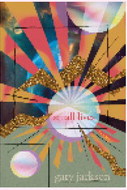

Title: “small lives” Author: Gary Jackson Published: 2025 Publisher: University of New Mexico, UNMPress. com One of the Mary Burnett Christiansen Poetry Series ISBN: 978-0-8263-6842-3 Paperback, 139 pages
“There is no friend as loyal as a book,” Ernest Hemingway
Poet Gary Jackson lures readers into a complicated universe where a team of black superhumans discover their powers. It’s a violent world filled with cynicism.
These adventurous super heroes’s endeavors highlight the fate of ordinary humans.
“At the rally, after locking every man in place, I ask each one the same question: What would you do if our positions were reversed? They each think the same answer, so I make a fist, make their bodies crack like ice when it hits hot water. The men still waiting their turn slowly begin to understand. Too late,” from “on corrective thinking.”
The prose piece “work” describes a mother’s faith in her young son. She is plagued by lingering doubts but dismisses any misgivings as the work of the devil.
“The boy knew she meant well but chances were he'd never leave town unless he had to, and although his mother told him no one lived small lives, he couldn’t help but feel some lives were large enough to see from outer space.”
Jackson chose the traditional poetic format for some pieces such as necropolis, Goliath, origin story and a different world.The poet credits a remark by a Stephen King character, Jake Chambers in “The Gunslinger,” as the direct source for the opening line in “a different world.”
“Go then there are other worlds than these, the boy says before falling into another book\\somewhere more comforting for our brutal imagination where everything we think is true …” from “a different world.”
Most of the poems in “small lives” are written in free form or blank verse.
“The Telepath turned broken telepath” is a prose piece that examines human culpability: “She saw the terrible things the president had done. . . Ashame the president could have allowed such things. But it’s not like he did it with his own hands … As if great men couldn’t make mistakes. As if she wasn’t also unclean.”
Referring to “rehearsal” Jackson notes that the impetus for this poem was based on current penal codes in the U.S. The judiciary in states such as South Carolina continues to rely on firing squads for death penalty cases.
The poet acknowledges finding inspiration in the works of authors such as James Baldwin who wrote“The Fire Next Time.” Baldwin’s book includes the line “God gave Noah the rainbow sign. No more water, the fire next time!”
The lyrics of “Jealous Guy” influenced the poem “newscast.” The poet noted that this song is featured on Lennon’s 1971 album, Imagine.
Jackson relives some of his life experiences in many of these poems. The knowledge he has gained is channeled into “small lives.” His writing encourages readers to expand their imagination and see new perspectives.
“These poems blur genres and open your mind to witness amazing feats, the rise and fall of heroes, and maybe even a world saved from itself,” wrote poet Juan J. Morales, who penned “Dream of the Bird Tattoo: Poems and Suenitos.”
Sidebar:
Gary Jackson, a Kansas native, earned his BA from Washburn University, Topeka, Kansas, and his Master of Fine Arts from University of New Mexico, Albuquerque.
Jackson is the recipient of both Cave Canem and Bread Loaf fellowships. The 2013 New American Poetry Series by the Poetry Society ofAmerica featured Shattered: The Asian American Comics Anthology.
He was co-editor of The Future of Black:Afrofuturism, Black Comics, and Superhero Poetry (Blair, 2021). His works have been published in Callaloo, The Sun, Los Angeles Review of Books, Copper Nickel, and elsewhere.
Jackson serves as the Toi Derricotte Endowed Chair of English, Dietrich School of Arts and Sciences at the University of Pittsburg, Pennsylvania, and also the African American Poetry and Poetics director.
His books include Missing You, Metropolis (2010), which was the winner of the 2009 Cave Canem Poetry Prize, and origin story (2021), and “small lives” (2025), which is divided into four sections plus an epilogue.