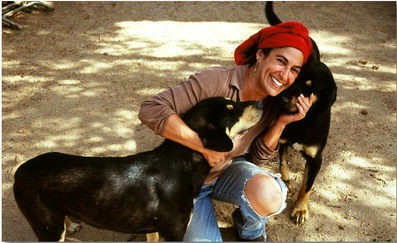
Maye Torres scoffs at the notion security. The Taos artist isn’t so fond of imposed social and cultural constructs, either.
“It’s really about how can we follow our dreams?” Torres said.
And dreams, especially for women and women artists, are sometimes in a head-on collision with safety, especially the financial and social variety.
These and other issues that both women and women artists face, are the subject of the documentary by award-winning filmmaker Pamela Tanner Boll, “Who Does She Think She Is?”
Torres will be at a screening of the film at NMSU-Grants on Sept. 8 at 5:30 p.m. The event is free to the public and Torres will be on hand for conversation and questions following the film.
The 2008 documentary follows five women artists, including Torres, as it explores a number of issues that women, and women artists – still – face: mothering versus creativity, partnering versus independence, economics versus art.
It’s about “women who are daring to break the rules of what society tells us to do,” Torres said, adding “men, too.”
Some 15 years after the film’s release, the issues are still alive and with us. As Tanner Boll demonstrates in the film, most people are hard pressed to name even a handful of women artists, even though women can far outnumber men in master of fine arts programs. Conversely, the majority of art featured in galleries is still created by men.
I saw the film in a tiny Vancouver, Wash. art gallery while working on my own MFA in creative writing. At the time, I sorting through lots of who-do-you-think-youare fodder, with the notso- subtle message that I really should just keep quiet and conform to the ruts of social norms. While I obviously chose to decline the conformity invitation, I still hear the message, often pressed through gritted teeth.
As the director of adult education at NMSUGrants, I often see women struggle with social pressures as they work to earn their high school equivalencies and improve their lives, and the lives of their families, through education. About 72 percent of our adult education students are women. And the heart-wrenching reality is that some 20 percent of our county residents do not have a high school diploma, or its equivalency, according to the Economic Development Department. The national average for the U.S. is 8.9 percent.
While following a dream to create art might not seem linked to following a dream to continue an education, the two are intertwined. Both require drive, passion and the wherewithal to move past difficult pressures and voices.
In a perfect world, we might all help each other to rise up, overcome and achieve in the face of adversity.
Meanwhile, we can explore ideas, issues and conversation, all with the hope of making the world a more verdant place.
“The art, it ends up giving back to the world,” Torres said.
Please join us for the film and conversation.