
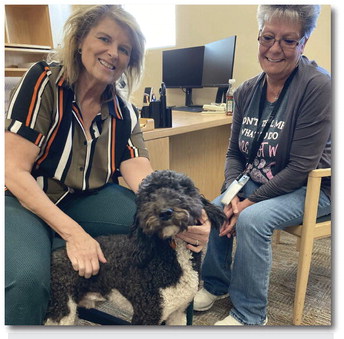
GRANTS, NM – Testifying in a courtroom is often an extremely intimidating and scary experience for anyone, but for victims of violent crimes, it can be debilitating. That’s where Cowboy comes in. He’s a brown and white standard poodle with a surprisingly mellow disposition for a dog who’s just shy of twoyears- old. According to the 13th Judicial District (Cibola, Sandoval, and Valencia County) District Attorney, Barbara Romo, “He gives the victim the strength to tell their story.”
Cowboy is an emotional support animal. He has been trained since birth by the Santa Fe-based Assistance Dogs of The West to be employed by the legal system to do just what he does - be there for crime victims. Cowboy lives with Nina Salazar, the director of the Pre-Prosecution Diversion program. Salazar is also Cowboy’s primary handler. Victim Advocates communicate with Salazar to let her know if they have a client who might benefit from the unique supportive service that Cowboy offers - a calm and quiet presence that can feel healing during a stressful time.
“We worked with about five dogs a day. I went through 4-5 day training, and whatever dog connects with you is the one you get assigned to,” Salazar said, explaining how Cowboy joined the DAs office. Once she was assigned to Cowboy, she had to travel to Santa Fe to start the training that would last for over one year.
“In trial or pre-trial interviews, the victim can be with the dog,” Romo said. As far as entering the courtroom, it’s entirely up to the judge. Some judges are fine with it, and some are not. “Judge Villalobos is really on board with the dogs in the court.” Romo said she’d like to have one dog for each of the three offices, but for now, the budget only allows for one. Cowboy’s special skills come with a hefty price tag $33,000.
In a recent trial, a woman who was raped was able to experience the special support that Cowboy can offer. “He (Cowboy) really attached to her,” Salazar said. “Throughout the whole trial he stayed close to her. He laid by her, so she knew he was there.” Salazar said that though Cowboy is such a loving, supportive presence, he will let her know if he is not wanting to be around a certain person. “He’ll nudge me to let me know if he’s not okay.” Right now Salazar said that they were preparing for two trials in Valencia County, and both trials include children. She said Cowboy loves the kids. “You can literally see a kid’s demeanor change when they’re with him,” Romo added.
According to Romo and Salazar, the use of Cowboy has to be planned far in advance so all parties get the time to build a relationship, and people need to understand the value of this process. “Nina’s done training in all three offices, so they do understand the process.”
According to Salazar, most emotional support dogs work for five to eight years before they are retired from service. When Cowboy’s retirement time comes, he’ll stay with Salazar who said she would leave the country with him if anybody tried to take him away from her. If for some reason, Salazar cannot be present at a legal event, Cowboy has a secondary handler in Chief Deputy DA Jessica Martinez who will begin special training soon.
“Trials should be where people can tell their truth. They have to be relaxed enough to fully explain in their own words what happened,” Romo said. With no legal background and only a good nose and big heart, emotional support dogs like Cowboy help people relax enough to tell their truth. According to The National Center for State Courts, there are currently 262 courthouse facility/support dogs working in 41 states.