
GRANTS, N.M. – True to the predictions of local environmentalists over the last 20 years, groundwater contamination from the Homestake uranium mill site is not going away. The focus now is how to manage it into the future so that it does not contaminate the San Andres-Glorieta aquifer which provides drinking water for local communities.
Officials from Homestake Mining Company of California met with concerned residents for nearly three hours Sept. 9 at New Mexico State University to update them on remedial actions that have been ongoing since the mid-1970s, and to explain why Homestake believes an Alternate Concentration Limit is the path forward.
In the more than 40 years of groundwater corrective actions, Homestake has removed and treated over 12 billion gallons of affected groundwater, reducing contaminants to levels that are as low as reasonably achievable.
Over 80% of the uranium mass that made it's way out of the Large Tailings Pile and into the groundwater has been removed. “That's about 1.3 million pounds at a cost of over $400 million,” Eric Burch, program manager for Barrick Gold's Grants Reclamation Project, said.
The U.S. Nuclear Regulatory Commission issued a confirmatory order to Homestake in 2017 requiring the company to reevaluate its groundwater corrective action plan to determine how the cleanup was going and whether the plan was working.
Homestake went back to the drawing board and spent years characterizing and modeling in an attempt to understand the extent of the contamination.
“The results were unfortunate,” Burch said. “It's just not possible to clean up the contamination to meet groundwater standards in any type of reasonable timeframe. 'Technically infeasible' is the regulatory term.”
Changing the limits
Under NRC regulations, if a company can't clean up the contamination to background levels, it must implement institutional controls such as fencing and restrict access and use of the groundwater to protect humans and the environment.
“This is the path forward under Nuclear Regulatory Commission requirements, so we're following the path,” Burch said.
To this end, Homestake has submitted a revised application to the NRC requesting an Alternate Concentration Limit for its Groundwater Corrective Action Program. This includes license amendments to remove the requirements for groundwater corrective actions and modification to the groundwater monitoring program and reporting frequency.
In conjunction with final site decommissioning and reclamation, a separate future license amendment will be filed to transfer the site to the U.S. Department of Energy's Office of Legacy Management for long-term management to protect public health and safety and the environment for 1,000 years, “to the extent reasonable achievable,” or for at least 200 years, according to the ACL application.
To pursue the ACL path Homestake developed an “extremely robust” groundwater model to determine what contamination from the site is going to look like over the next 1,000 years. From 2022 to 2025, Homestake worked cooperatively on the model with the NRC, DOE, U.S. Environmental Protection Agency and New Mexico Environment Department. Following an audit and tweaking to address concerns and questions, a revised ACL application was submitted June 30 and is now under NRC review.
A Little History
Homestake partnered with the federal government to provide critical nuclear materials – yellowcake – for national defense and later, energy. The facilities were constructed in the 1950s according to the standards of the time.
“But this was before the EPA. This was before the Clean Water Act, before we really understood what those dangers were associated with the mining and milling activities,” Burch said. “So even though these facilities were built to the standards of the time, there was contamination from the tailings facility into the underlying alluvial aquifer, and that contamination required remedial actions, starting in 1975, which have been continuing through to today.”
Constituents to be addressed in the ACL application include metals: arsenic, cadmium, molybdenum, selenium, vanadium; as well as radionuclides: uranium, combined radium-226 and radium-228, and thorium-230. Fluoride and nitrate also have been identified.
Homestake has plugged and abandoned more than 800 obsolete wells. This year workers are putting the final cover on the Large Tailings Pile. “It was many years of going back and forth to make sure that that cover was appropriate and was going to last for that 1,000 year time period, per NRC regulations,” Burch said. Homestake is approximately 75% complete with that project and expects it to be completed in early November.
The ACL application does include a proposed groundwater monitoring program. “In keeping with this ACL process, you don't just throw your hands up and walk away,” Burch said. “You continue to monitor it into perpetuity to ensure that what the model predicts is actually bearing out in reality, so that if you have to do something, you can catch it before it becomes an issue.”
Controlling the plume
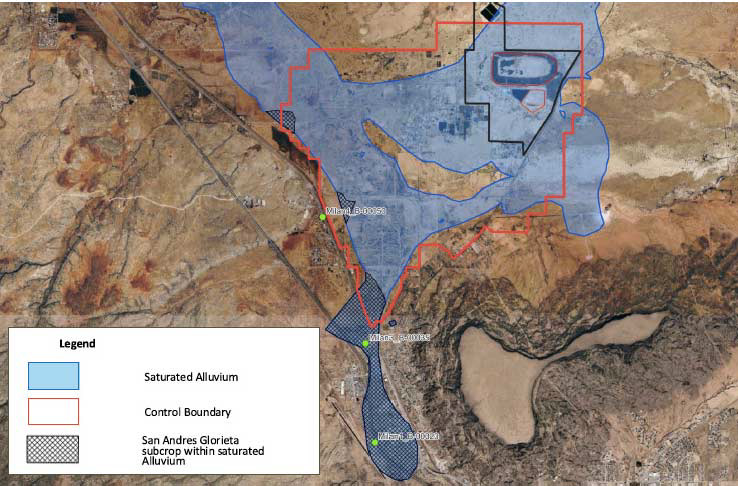
Adam Arguello, closure manager, has spent the last eight years as the primary person for Homestake working on the ACL application. He and Burch presented a map which showed what the contaminant plume is projected to look like in the future. It included a red “control boundary,” which Burch said is like a line in the sand. “On one side of the line the water is usable. On the other side of the line it's not.” Dark blue hatched areas showed where the alluvium is in contact with the San Andres-Glorieta and where contaminated water from the Homestake site potentially could enter the SAG near the Village of Milan municipal supply wells, which are outside the long-term care boundary.
The boundary is based on a maximum contaminant level of .03 milligrams per liter for uranium. “That's just one constituent,” Burch said. “Beyond the red boundary the concentration of uranium in groundwater is less that .03 milligrams per liter.”
Laura Watchempino from the Pueblo of Acoma asked what the newly proposed ACL standard for uranium would be, to which Burch responded, “15 milligrams per liter.”
“Not too protective at all,” Watchempino said.
Burch agreed. “You're right. At the point of the pile, the point of compliance, it is above the standard. To be clear, everywhere within that red boundary is above the standard and that's the reason for restricting access. Beyond the boundary it is below the standard.”
High and dry?
“What you see on this map is alluvial saturation,” Arguello said. “Underlying this are three sandstone members in the Chinle group that have shown impacts. So the boundary includes the impacts we have there.”
Ava Curtis, who represents the Multicultural Alliance for a Safe Environment, said, “I know this is a future prediction but what are you going to be doing to stop the alluvium from getting into the San Andres-Glorieta?”
Arguello explained that the purpose of the modeling is to predict how mass is going to move in the system. A specific investigation was done in 2021 to understand the contact between the alluvium and the uranium mass, and that was incorporated into the model.
The contaminants don't travel at the same velocity as groundwater, Arguello said. “Groundwater goes very slow. We're talking feet per day at most. Saturation decreases significantly over the next 200 years. ... If there's no flow path for water to get there, the mass can't get there either,” he said.