
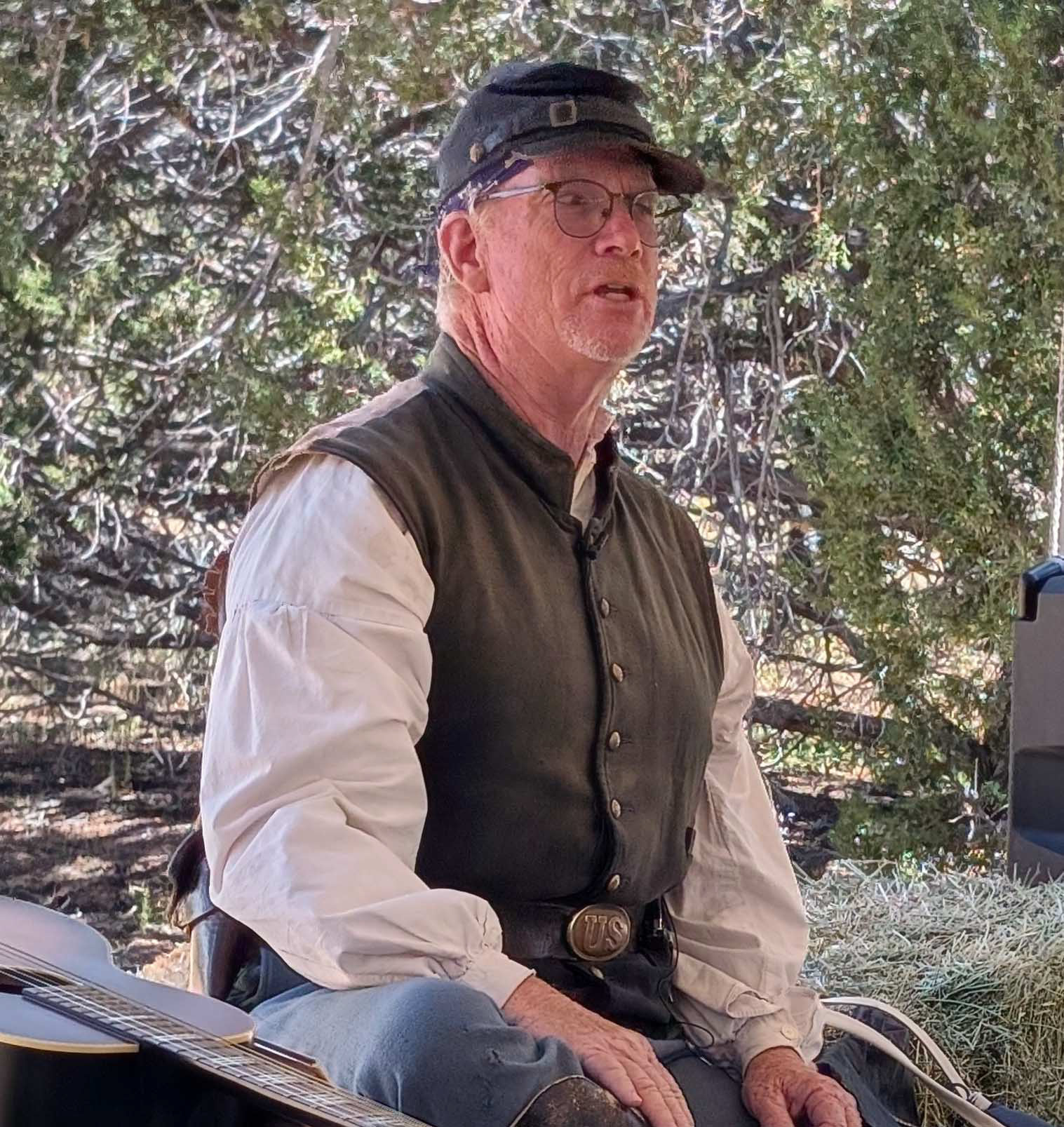
Doug Baum’s Historical Account at El Morro
CIBOLA COUNTY, N.M. The El Morro Camel Corps event took place September 12 and 13, featuring presentations by camel expert Doug Baum. In the mid-19th century, the U.S. Army embarked on an unusual experiment: the use of camels for transportation across the American Southwest.
Reflecting on May Humphreys Stacey’s journal, published as Uncle Sam's Camels, Baum expanded on the journal entries of the 19-year-old soldier from Philadelphia.
Firstly, Baum explained that the camels were intended to supplement, not replace, horses and mules. They were remarkably selfsufficient, consuming local vegetation like bark and pine needles and requiring water only when near a source. Their resilience made them ideal for the harsh environments of the frontier.
As the Camel Corps moved from Texas to California, the young soldier documented the journey with practical notes about grazing conditions, firewood availability, and other basic everyday things. Then, Baum noted, Humphrey’s writing begin to reveal a personal and romantic side in El Morro. On August 24, he penned a reflective entry about visiting Inscription Rock, describing it as “a beautiful place, secluded and secure, fit for the echo of words of love,” a spot he believed he would remember for the rest of his life.
Baum went on to explain that the expedition’s route took the group past Zuni Pueblo. By the mid-19th century, the Zuni people were accustomed to seeing horse, mules, and wagons, but camels were a new sight. Although historical accounts often emphasize conflict between U.C. forces and Indigenous peoples, this particular episode was peaceful. The Zuni traded corn to the expedition, which fed the horses and mules, while the camels continued to thrive on the local vegetation.
Led by Edward Fitzgerald Beale, the expedition surveyed a route along the 35th parallel, which would later form the basis for Route 66 and, eventually, parts of Interstate 40. The caravan sometimes stretched over two miles, including infinity, wagons, mules, sheep, and camels. Early guidance from local scouts occasionally led the group to the edges of canyons, illustrating the challenges of charting routes through unfamiliar terrain.
Baum noted that Beale’s journey left a lasting imprint on the American West. His name, carved at Inscription Rock and commemorated in small monuments along the route, lived on in the region’s history. The expedition demonstrated the feasibility of overland travel through intimidating landscapes and briefly highlighted the potential of camels as a practical asset for frontier exploration.
While the camels were a logistical success, the project faced political challenges. Initiated in 1855 under the leadership of then Secretary of War Jefferson Davis, the program became politically tainted after the Civil War. By 1865, Davis’s association with the Confederate states— specifically being the President of the confederate states— made the Camel Corps unpopular, and the animals were eventually sold off or otherwise dispersed.
Although some camels escaped and roamed the wilderness, their numbers were small. Over time, additional camels were imported for private use. Today, approximately 10,000 camels live in the United States, used for agricultural purposes, recreation, and historical interpretation. The Camel Corps represent a unique and often overlooked chapter in American history, blending innovation, human experience, and the practical realities of frontier life, Baum explained. The journals of young soldiers like Humphrey proved a rare glimpse into both the operational details and details and emotional resonance of this journey.