
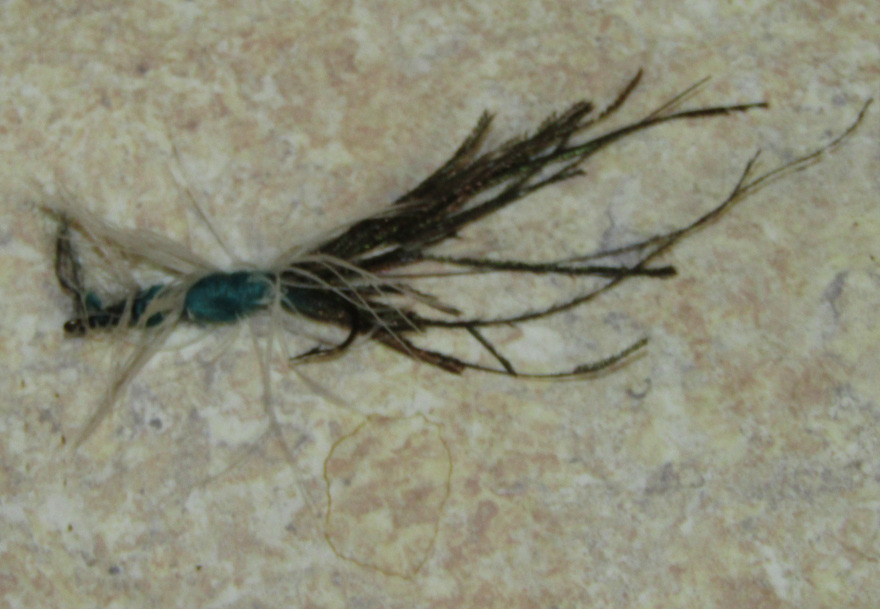
Recently, as I was rummaging through my cigar box turned treasure chest, and not looking for anything special, I happened upon a fishing fly that I had placed here years ago and had forgotten about. I pondered over the fly for some time, looking at its rather odd shape and somewhat crude construction.
The hook was rather large in respect to what one would use for stream fishing, perhaps a number 6 or so, the size normally used for lake fishing, for maybe catfish. The feathers that were tied upon the hook’s shank were dark, mixed with green shades, and of long stems. They were attached with what appeared to be brown sewing thread. There were many knots of sorts attaching the feather body to the hook at no particular intervals.
I was interested in the origin, type of fly, and primarily what it was used to catch. I already had a clue about this fly, but to confirm my idea I picked up a book at Charlie’s Sporting Goods in Albuquerque, called “Concise Hand Book of Fly Tying”. There, I discussed the fly with Chuck Domenici and my friend Dave Purvis and one question in particular that was asked was that if it was a wet or dry fly. That may help define its use. I would research this.
As I read, I learned about a vise that could be used to hold the hooks shank, most often to a table’s edge, while string is wound onto appropriate material to form a copy of an insect’s abdomen and thorax. There is a bobbin to hold your spool of thread, as well as hackle pliers for use in creating flies. Wings would be shaped with special scissors, and often a drop of epoxy would be uses to secure the threads’ end. Elk hair is often used as well as muskrat hair to give the desired wing or tail effect. There are commonly recognized names as Adams (dry fly), along with Elk Hair Caddis (another dry fly), and Wooly Booger (a streamer fly).
I retrieved the fly from the box and re-examined it. I knew most of the description now and its identity, and recalled its origin. Now I was captured by the fly’s beauty. This was crafted by my youngest daughter Regina, with possibly help from her older sister Elisa about 36 years ago. The feathers as I recall were of peacock origin, from the Gottlieb Ranch east of Grants; they resided in a vase in our bedroom for years until they started falling (or possibly plucked) apart. I envisioned the little five year-old struggling with tiny fingers to tie the feather parts onto the sharp hook, intently focused with a wrinkled brow and upturned tongue out of the corner of her mouth. Perhaps Elisa helped steady it as the newly learned “I can tie my own shoes now” knots were placed onto the feeble-bodied fly.
This would be appropriately named, “HAPPY FATHERS DAY, I LOVE YOU” fly, with a hint for immediate use. I smiled immensely and recalled the many happy times we fished together, and the joy it brought to our children. I softly squeezed the fly between my thumb and forefinger and clutched it to my breast. My eyes started welling up with tears and my smile remained unbroken. I blinked and a tear rolled down my cheek and landed onto my clutched hand….. It is a wet fly. I thought of what it could catch…… and for the second time in my life…… it has caught my heart.